Full VIN report: Romania + international
The car's entire history in one report: RAR data, international damage records, theft check, usage history.
Availability details →Order
This service launches soon at 129 RON. Meanwhile you can order any other document on the site.
See all documents →What is it?
The full VIN report combines the Romanian RAR history with queries in international databases: damage reported in other countries, historical mileage records, theft status, taxi/fleet use and historical listing photos, where available.
Everything starts from the VIN, the 17 character chassis number that identifies one specific car and stays with it for life. Plates change with every owner and with every country, which is why no serious check starts from them. You will find the VIN on the registration document, in the bottom left corner of the windscreen and usually on a plate inside the driver's door frame.
The Romanian record only knows what happened while the car wore Romanian plates. For a car imported from Germany, France or Belgium, that story can be very short and very clean. The full report exists for exactly this gap: it queries international databases alongside the Romanian record, so the years spent abroad stop being a blank page.
What comes back varies: damage reported in another country, odometer readings recorded there at inspections or services, theft status, a spell as a taxi or in a rental fleet, and photographs from old classified adverts where they exist. The photographs are often the part that settles everything, because a car photographed two years ago with a destroyed front end and advertised today as never damaged needs no further expertise.
Coverage is not uniform, and pretending otherwise would be dishonest. It depends on the country the car came from and on how old it is, because countries do not record the same things and do not share them in the same way. An empty result is not proof that a car is clean. It means nothing was found in the sources that could be reached, and a repair paid for directly, without an insurer, appears nowhere.
The report is not a technical inspection. It tells you what was recorded about the car, not what state it is in this morning, so it comes before a visit to a mechanic rather than instead of one. It also does not cover pledges, leasing contracts or other debts registered against the car in Romania, which live in the movable assets register and are checked separately.
The usual mistake is the order of operations. Someone falls for a car, pays a deposit to hold it and checks afterwards. From that point a bad result no longer means walking away, it means negotiating a refund with a person who already has your money. The check belongs before the deposit, not before the signature.
Before reading the report, compare the VIN on the car with the VIN on the papers. The stamp on the body, the windscreen corner, the plate in the door frame and the registration document should all say the same thing. A mismatch ends the conversation, no matter how good the rest of the history looks.
Do not accept a report the seller shows you. A screenshot proves neither which car it describes nor when it was produced, and it takes two minutes to edit. The check has to run on the VIN you read off the car yourself.
A report with findings is not automatically a reason to walk away. Damage that was properly repaired is a price argument, and knowing about it puts you in a better position than the seller who hoped you would not ask. What changes is the basis of the discussion: you stop negotiating on the advert's description and start negotiating on the record.
The full report earns its place mainly in one situation: the car has been in Romania for a year or two and spent the previous decade somewhere else. For a car that has lived its whole life on Romanian plates, the Romanian history report answers most of the question on its own. Ask yourself where the car has been before choosing which check you need, rather than taking the bigger one out of habit.
To run the check you need the VIN and nothing else. No consent from the seller, no plate number, no access to the car's papers beyond reading that one number. The car does not have to be registered in Romania, and buyers based abroad use the same check for cars they are considering here.
When you need it
- Complete checks on imported cars (Germany, France, Belgium etc.)
- Detecting hidden damage from abroad
- Checking the theft status
- The final decision before buying
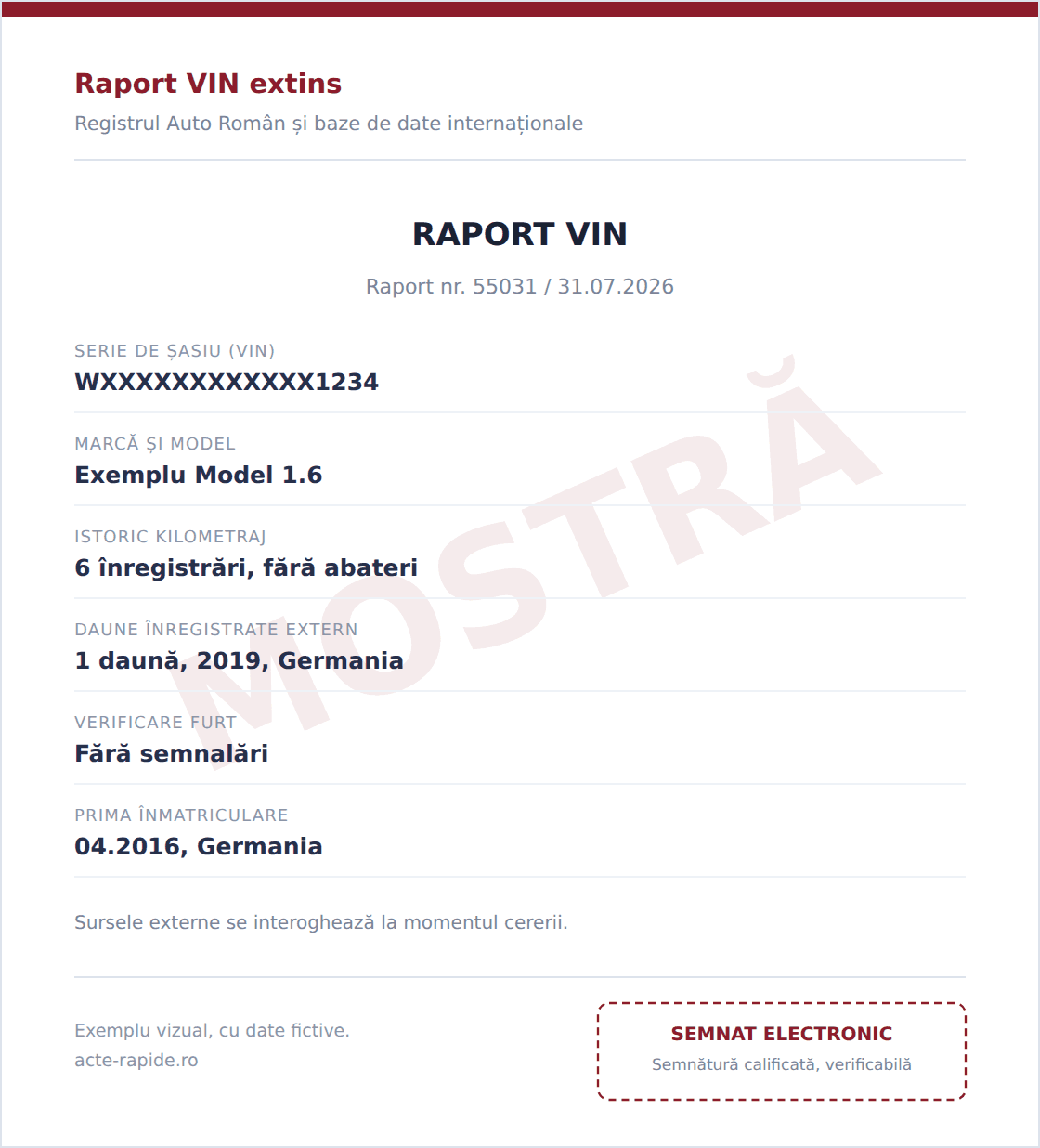
What the document contains
- Everything in the RAR history
- Damage and events from international databases
- Theft check
- Multi-country mileage history, where data exists
How it works
Three simple steps, from your phone or laptop.
Chassis number (VIN) + your contact details. Under 2 minutes.
Bank card, Apple Pay or Google Pay. The invoice arrives automatically by email.
It arrives by email in ~30 minutes. We also notify you by SMS.
Frequently asked questions
About this document
How is it different from the plain RAR history?
The RAR history covers only events in Romania. The full report also queries international databases, which is essential for imported cars.
Do you find data for every car?
Coverage depends on the country of origin and the age of the car. If we find nothing beyond the RAR data, we tell you so.
This service is launching soon
Online ordering is being reworked. Meanwhile, see the documents available today.
See all documents →