RAR vehicle history: real mileage and damage, in ~10 minutes
The mileage recorded at every periodic inspection and the damage reported by insurers, checked before you pay for a used car registered in Romania.
Order now →Order now
It takes under two minutes and you don't need an account.
What is it?
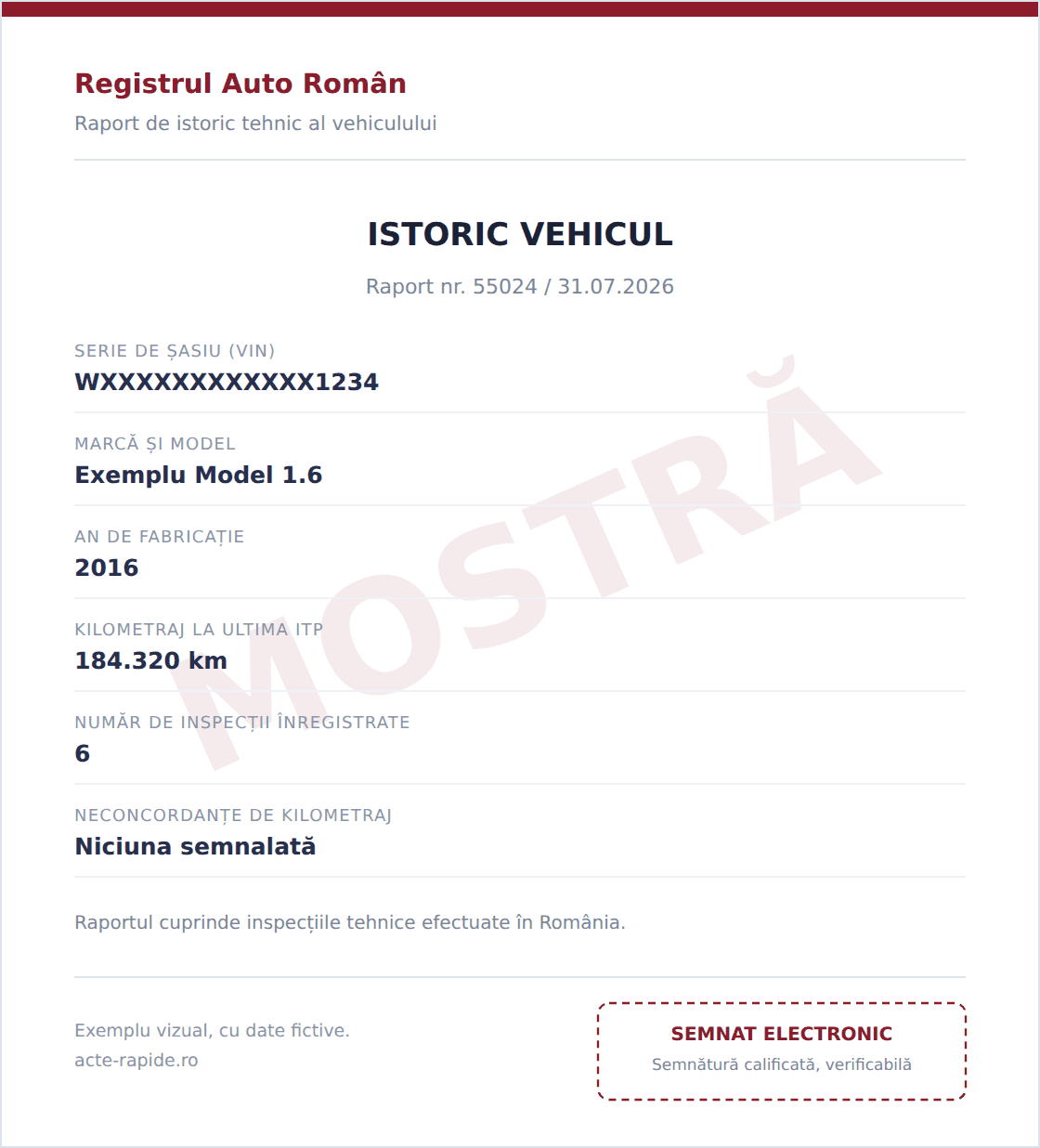
The vehicle history from the Romanian Automotive Register (RAR) gathers the mileage recorded at every periodic technical inspection (ITP) in Romania, damage reported by insurers and other events in the car's life.
This is how mileage rollback comes out: if the car had 250,000 km at the 2023 inspection and now shows 140,000, the difference is there in the report.
Every car registered in Romania goes through a periodic technical inspection, and the odometer reading is written into the RAR record at that moment. Over the years this builds a dated series of numbers, and the series should only ever climb. Read it from the oldest entry downwards and you get the car's real working life instead of the version in the advert.
Look at the pace between entries, not only at the drops. A car that covered a steady distance every year and then suddenly shows a fraction of that in the two years before the sale is usually telling the same story as a negative jump, only more quietly. Mileage is the most expensive number in a used car listing, because both the asking price and how much life the engine has left hang on it.
Besides the inspection readings, the report carries damage reported by insurers where such records exist, the RAR inspections themselves and the technical identification data of the vehicle. Reported damage does not make a car unsellable. It changes the fair price, and it tells your mechanic exactly where to look before you sign anything.
The report covers Romania. Whatever happened while the car was registered in another country sits outside it, which matters for imports: a car brought in last year can have a short, spotless Romanian record and a long history somewhere else. It also says nothing about pledges, leasing contracts or any debt attached to the car, and nothing about its mechanical condition today. Those are separate checks.
All you need is the chassis number, the 17 characters of the VIN. It is on the registration document, in the bottom left corner of the windscreen and usually on a plate inside the driver's door frame. You do not need the seller's consent, and you do not need the plate number, which changes with every owner anyway. Before anything else, check that the VIN stamped on the car matches the one on the papers.
A seller who will not give you the VIN from a listing has already answered part of your question. There is nothing confidential about it, because it identifies the car and not the person. In practice the refusal usually means the history does not match the advert.
The right moment for the check is before the deposit, not before the signature. Once money has changed hands the conversation stops being about whether to buy and becomes about getting a refund, which is a slower and much less pleasant conversation. The check costs a small fraction of what a rolled back odometer costs.
If the report shows a rollback, you hold a dated document built on the official record. Walking away is the simplest answer. If you still want the car, the price has to be renegotiated from the real mileage rather than from the dashboard, and the sale contract can record the mileage the seller declares, which puts the claim in writing where it belongs.
Two things this report is not. It is not a valuation, so it will not tell you what the car is worth, only what happened to it. And a clean report is not a guarantee: it means nothing was recorded, which is not the same as nothing having happened. Damage settled privately between two drivers never reaches an insurer, and a car that skipped inspections leaves gaps in the mileage series. Read it as evidence, not as a certificate.
Buyers based abroad use it the same way Romanian buyers do, because the check needs nothing but the VIN and an email address. The report reflects Romanian records, so it is the right check for a car that has spent its life on Romanian plates. For a car recently imported into Romania, the fuller VIN report that also queries international databases is the one likely to have something to add.
When you need it
- Checking a used car before purchase
- Detecting mileage rollback
- Checking the damage and accident history
- Negotiating the price based on the real history
What the document contains
- Mileage recorded at every technical inspection
- Damage reported by insurers (where available)
- RAR inspections and checks
- Technical identification data of the vehicle
How it works
Three simple steps, from your phone or laptop.
Chassis number (VIN) + your contact details. Under 2 minutes.
Bank card, Apple Pay or Google Pay. The invoice arrives automatically by email.
It arrives by email in ~10 minutes. We also notify you by SMS.
Frequently asked questions
About this document
What do I need to order?
Only the chassis number (VIN), the 17 characters. It is on the registration certificate or on the windscreen.
The car was recently imported. Will the history show?
The RAR report covers events in Romania. For recently imported cars we recommend the Full VIN report, which also queries international databases.
How long does it take?
Usually about 10 minutes, 24/7.