149 RON (about €29), by email in ~10 minutes, electronically signed
Romania's UBO register (Registrul Beneficiarilor Reali, RBR) is the National Trade Register's official record of the natural persons who ultimately own or control each Romanian company. If a compliance team, a bank or a KYC questionnaire has asked you for proof of a company's ultimate beneficial owner, this register is what they mean. It exists because EU anti-money-laundering law requires it, and since a 2022 ruling of the EU Court of Justice it is no longer open to the general public. This guide explains what is in it, who can obtain an extract in 2026, and what to do when you cannot.
Who counts as a UBO under Romanian law
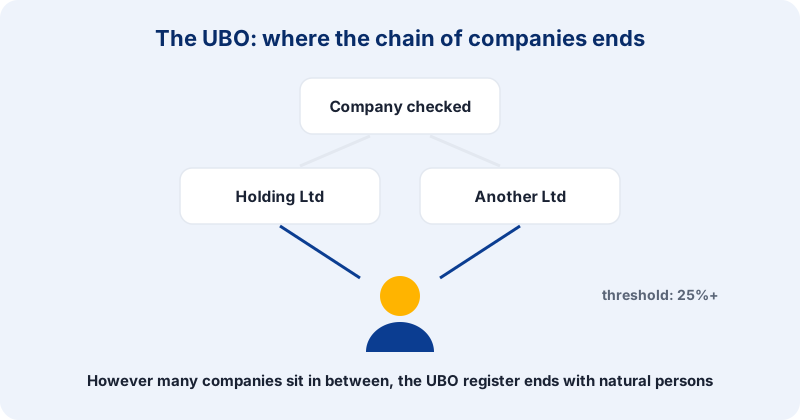
Romania transposed the EU anti-money-laundering directives through Law 129/2019. The ultimate beneficial owner is the natural person, never a company, who ultimately owns or controls the entity. The main test is holding more than 25% of the shares or of the voting rights, directly or through other companies. Where no one crosses that threshold, control through other means is examined, such as the power to appoint the management. Where no person can be identified either way, the senior managers themselves are recorded. Every chain of holding companies ends, on paper, with named physical persons.
What Romanian companies must declare
Almost every Romanian company files a UBO declaration (declarația privind beneficiarul real) at incorporation and again within 15 days of any change in ownership or control. The declaration names each beneficial owner with identifying data and describes how control is exercised. Failure to file starts with fines and can end, after repeated warnings, with the company being dissolved in court at ONRC's request. Romanian courts have actually dissolved companies for this, so the register is reasonably well populated, and its data is treated as reliable by banks and authorities.
Why the public lost access in 2022
Until November 2022, anyone in the EU could consult beneficial ownership registers. Then the Court of Justice ruled, in joined cases C-37/20 and C-601/20, that unrestricted public access was a disproportionate interference with privacy, and registers across the Union closed overnight. Romania followed, and its current rules require anyone outside the exempt categories to demonstrate a legitimate interest before ONRC releases the data. Authorities and institutions with anti-money-laundering obligations, such as banks performing customer due diligence, retain access. A journalist investigating money laundering, or a company about to sign a significant contract, can qualify with supporting documents. Curiosity does not qualify.
What the 2024 reform changes
The closure of 2022 was not meant to be permanent. Directive (EU) 2024/1640, the sixth anti-money laundering directive, rebuilds access around a legitimate-interest test instead of removing it, and it puts member states on a timetable: access guaranteed by 10 July 2025, the register provisions developed by 10 July 2026, full transposition by 10 July 2027. Romania is behind that schedule, and so are many others. The dates, the categories that qualify and what an application actually involves are set out in our guide to access to Romania's UBO register in 2026.
How an extract is obtained in practice
The extract comes from ONRC, in two forms: the current situation, at a state fee of 20 lei, and a historical report showing every UBO ever declared, at 100 lei. The procedure is the honest difficulty. Requests go through ONRC's online portal, which runs in Romanian only, and an applicant relying on legitimate interest attaches supporting documents to every single request: identity document, a power of attorney where someone applies on another's behalf, and the proof of the legitimate interest itself, such as the draft contract with the company being checked. ONRC staff review the file before any document is released, so this is a matter of days rather than minutes, and a request without convincing justification is refused. We file these requests ourselves, as a registered reporting entity, which is the reason the UBO extract can be ordered here for 149 RON and normally arrives by email in about ten minutes, without anyone touching the Romanian-language portal. The extract itself is the official ONRC document, in Romanian; what we handle in English is the ordering and the correspondence.
If you need it for your own company
The company's own legal representative can always obtain its UBO extract, with a mandate where an intermediary files the paperwork. Foreign shareholders usually hit this need during bank onboarding abroad, when the bank wants registry proof of the ownership chain behind their Romanian subsidiary. If that is your case, the practical route is to have your Romanian administrator request the extract, or to issue a power of attorney to someone in Romania who will.
UBO registration is a different thing from the extract
Two operations get mixed up under the same name. UBO registration means the company filing its beneficial owner declaration with ONRC: every Romanian company does it at incorporation, and again within 15 days whenever the beneficial owners change. That filing is made by the company itself, through its representative, and failing to keep it current draws fines and, in stubborn cases, dissolution proceedings. The extract is the opposite direction: a document pulled out of the register, showing what has been declared. If a bank asked you for proof of a company's UBO, you need the extract, not a new registration. If your own company has changed shareholders and the register still shows the old owners, you need the declaration filed first, because the extract will faithfully reproduce whatever is on record, outdated or not.
What you can get today without the UBO register
For most due-diligence purposes, the Trade Register certificate (certificat constatator) already answers the first layer of the question: it lists the direct shareholders of a Romanian company with their stakes, its directors, status and registered details, and ONRC issues it without any legitimate-interest test. Where the shareholders are themselves companies, a certificate can be pulled for each layer until you reach people. It is not the formal UBO extract a regulator may insist on, but it is official, electronically signed, obtainable in minutes through our English-language service, and for a first pass at who stands behind a partner it usually settles the matter. And if you do need the formal document, we obtain that too: the UBO extract can be ordered online with the company's tax ID (CUI) for 149 RON and usually arrives by email within about ten minutes during ONRC working hours.
Fill in a form, pay online and receive the electronically signed document by email.
Order the UBO extract online (149 RON, ~10 minutes) →