79 RON (about €16), by email in ~10 minutes, electronically signed
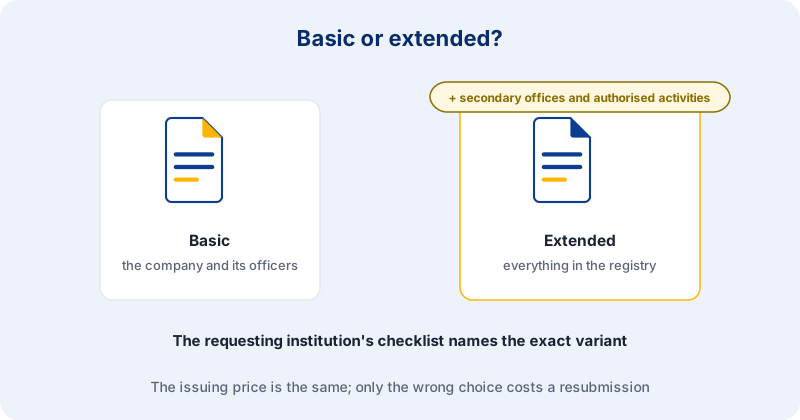
The basic certificat constatator shows a Romanian company's main registry data: identification, registered office, legal status, share capital, shareholders, directors and its declared activities. The extended version adds the secondary offices (working points) and the activities the company is actually authorised to perform at each of them. A third variant, the historical certificate, goes further and lists every registry entry since incorporation. The names sound bureaucratic; the choice is simple once you know what the receiving institution wants to see.
What the basic version contains
Identification data (name, tax ID, registry number), registered office, the company's status (active, suspended, insolvent, struck off), share capital, shareholders with their stakes, directors and empowered persons, and the activities listed in the articles of incorporation. For most questions of the form "who is this company and who signs for it", that is enough: banks opening accounts, partners before a contract, courts checking legal standing.
What the extended version adds
Two things: the secondary offices with their addresses, and the activities actually authorised at each office. The difference between listed and authorised activities is practical. A Romanian company can have dozens of activity codes written into its articles, but it may only perform those for which it filed an authorisation declaration with the Trade Register. Anyone who needs proof that the company can genuinely perform a specific activity at a specific location needs this part.
Who asks for which
Banks and notaries are almost always satisfied with the basic version. Public tenders frequently require proof of authorised activities matching the contract's object. EU-funds files often name their own variant explicitly, and Romanian insolvency courts have theirs. The golden rule: read the requirement in the file's checklist rather than guessing, because the issuing fee is the same and only the wrong choice costs you a resubmission.
What we deliver
The certificate we deliver in about 10 minutes is the official ONRC document, electronically signed, and in its current form it includes both the basic sections and the secondary offices, authorised activities and the last three years of filed accounts, which covers what most institutions mean by "extended". The order form also offers the special types (EU funds, insolvency), and the declared purpose (bank, tender, notary and so on) is printed in the certificate's text, the way receiving institutions require. The variant with the company's full history is available in the same form at 399 RON.
The historical certificate
The historical version lists the registry entries filed since incorporation: changes of name and registered office, share capital increases and reductions, shareholders and directors coming in and going out, mergers, and any suspensions or reactivations. Lawyers use it in due diligence, because a company's present state can look clean while its recent past explains a great deal. Insolvency practitioners and courts ask for it when they need to trace who controlled the company at a given moment. If nobody has explicitly asked for the history, you do not need it.
How old can the certificate be
Registry data changes the day a filing is registered, so institutions want a recent document. In Romanian practice, a certificate issued within the last 30 days is what most banks, contracting authorities and notaries expect, and some files are stricter than that. Ordering one in advance to keep on file rarely helps: by the time you use it, it is either out of date or so close to the limit that the reviewer hesitates. Order it while the file is being assembled, not months before.
What the certificate does not show
It is not a tax clearance document. Debts to the Romanian tax authority appear in a separate certificate issued by ANAF, and a company can be perfectly in order at the Trade Register while owing money to the state. It is not a credit report either: filed accounts tell you something about size, not about whether invoices get paid on time. It does not list contracts, bank accounts, pending lawsuits or enforcement proceedings, and it does not certify that a company is solvent. Reading a clean certificate as proof of financial health is a common misreading by foreign counterparties.
Reading the document
Three fields carry most of the weight. The status tells you whether the company is active, suspended, in insolvency or struck off, and anything other than active should change what you do next. The directors section tells you who can sign and with what powers, which matters because a contract signed by someone without representation rights becomes a problem only when you try to enforce it. The shareholders section shows who owns the company and in what proportion, which is where you start when you need to identify the ultimate beneficial owner for your own compliance file.
Language, signature and use abroad
The document is issued in Romanian and arrives as a PDF carrying the Trade Register's electronic signature. That signature is what makes the file an original; a printout is a copy of it. If the certificate has to be filed outside Romania, ask the receiving authority two questions before you order anything: whether it accepts the electronically signed PDF, and whether it needs a sworn translation or an apostille. Those are separate steps handled by other providers and authorities, they take longer than the certificate itself, and they belong at the start of your planning rather than at the end.
The free alternative, honestly
Some basic company data can be looked up free of charge from public sources, and for a first check on whether a company exists and is active that is often enough. What you cannot get for free is the signed official document. A screenshot or a printout of a free lookup is not accepted by a bank, a notary or a contracting authority, because nothing certifies that it reflects the register at the moment it was produced. Use free sources to decide whether a conversation is worth continuing, and order the certificate when someone needs proof.
Common mistakes
Ordering the historical version because it sounds more thorough, when the file asked for the current one, and paying more for a document nobody will read past the first page. Ordering with the wrong stated purpose, since the purpose is printed in the certificate and some institutions will not accept one issued for a different use. And ordering by company name instead of tax ID: names repeat across the register, tax IDs do not, and a certificate for the wrong company means starting over.
Fill in a form, pay online and receive the electronically signed document by email.
Order a company registration certificate (79 RON, ~10 minutes) →