79 RON (about €16), by email in ~10 minutes, electronically signed
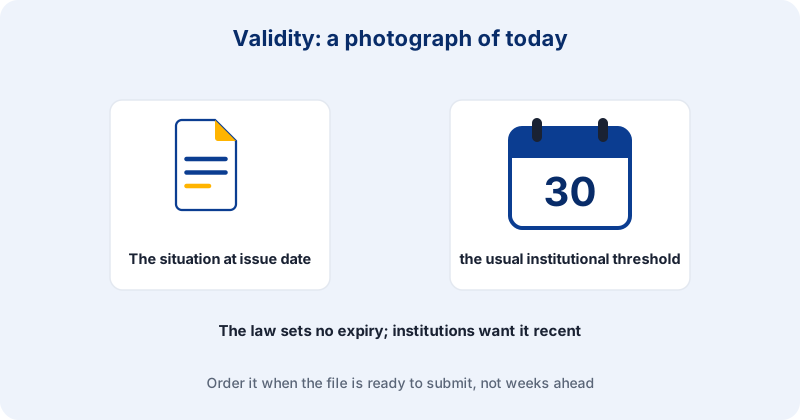
The certificat constatator has no legal validity period: it certifies a Romanian company's situation at the date and hour of issue, like a photograph. The "validity" everyone asks about is really the freshness requirement of the institution receiving it, and the most widespread rule in practice is that the document should be issued within the last 30 days. The document does not expire; the institution's trust in how current the photograph still is does.
Why the law sets no expiry date
The Trade Register changes daily. A certificate issued an hour ago can become inaccurate by tonight if the company files an amendment, and one issued three months ago can still be perfectly current if nothing changed. No fixed term could describe that, so each institution sets its own comfort threshold instead.
The thresholds institutions actually use
Banks typically want a certificate issued within the last 30 days, some within 15. Notaries likewise ask for 30 days in most offices, and for large transactions some want same-day issue. Romanian public tenders phrase it as information that must be real and current at the date of submission, which in practice means a certificate issued as close to the deadline as possible. EU-funds programmes write the exact term in the applicant guide, most often 30 days again. Courts tend to be more relaxed, but a fresh document spares the argument.
The practical rule
Order the certificate when the file is nearly ready to submit, not when you start preparing it. It is the one document in the file you can get online in about ten minutes, so there is nothing to gain from ordering it three weeks early. If the file slips and the certificate ages past the institution's threshold, you simply order another one; the price is the same and the file passes first time.
Authenticity does not age
Separate from freshness: the certificate issued online carries ONRC's qualified electronic signature and a verification code printed on every page, which anyone can check against the ONRC portal. That signature does not lapse after 30 days. An old certificate remains an authentic document about the past; institutions just want a recent photograph, not an archival one.
What can change between issue and submission
The 30-day rule is not bureaucracy for its own sake. Within a month a company can move its registered office, replace its administrator, transfer shares to a new owner, open or close a secondary office, suspend its activity, enter insolvency or be struck off. Any of those makes an older certificate describe a company that no longer exists in that form, and the institution that relied on it carries the consequence. Banks and notaries have both been caught out by transactions signed on the strength of a certificate that predated a change of administrator, which is why their thresholds are the tightest of the lot.
The mistake that has nothing to do with dates
Plenty of files are sent back with a perfectly fresh certificate in them, because it is the wrong kind. The basic certificate covers identification data, registered office, activity codes, administrators and share capital. The extended version adds historical detail and the filings recorded over time, which is what some institutions actually want. Ordering the basic one the day before submission solves the freshness problem and leaves the content problem untouched, so you order again anyway. Check which version the institution wants before you check how old it may be; our comparison of basic against extended sets out what each one carries.
Using the certificate abroad
Foreign counterparties usually treat the certificat constatator as the Romanian equivalent of what their own systems call a company extract or a certificate of good standing. Two things change once the document crosses a border. The translation acquires a date of its own, and a certified translation of a certificate issued in March does not keep that certificate current forever, so if the institution wants something recent you translate something recent. And where an apostille is required, it attaches to one physical copy: a new certificate means a new apostille, which is the step that eats the calendar. Order so that the certificate is issued as late as the apostille and translation lead times allow.
Paper, PDF and the verification code
The certificate issued online is a PDF carrying a qualified electronic signature, and that signature is what makes it authentic. Print it and you are holding a copy of an authentic document rather than the document itself. The printed page still shows the verification code, so a clerk who wants certainty can check it against the ONRC portal in under a minute, which is why institutions that accept PDFs usually prefer the file over the printout. If someone insists on a paper original with a wet signature, the online route cannot satisfy that, and it is worth asking whether their internal rules have simply not caught up with how the register now issues documents.
If the certificate you already hold is old
Nothing is wrong with it. Keep it, because it remains proof of what the register said on that date, which occasionally matters in a dispute about what a party knew and when. But do not slip it into a live file hoping nobody looks at the issue date: the date and hour are printed on the document and checking takes a second. Ordering a replacement is the cheaper move every time, and if nothing has changed in the meantime the two documents will read almost identically anyway.
What to ask before you order
Two questions to the institution, in one email. How recent must the certificate be, and do you need the basic or the extended version? With those answers the file goes through the first time. Guessing at either one is what turns a document you can obtain in ten minutes into another week of waiting, and the waiting is never caused by the register.
Fill in a form, pay online and receive the electronically signed document by email.
Order a fresh company certificate (79 RON, ~10 minutes) →