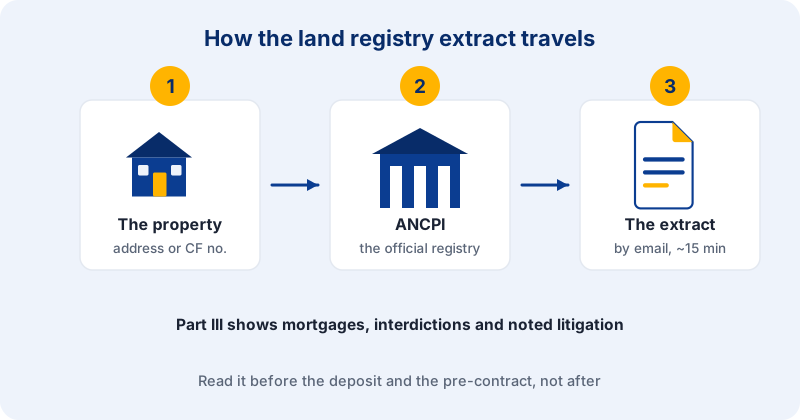
The Romanian land registry extract (extras de carte funciară) is the official ANCPI document showing who owns a property and what charges sit on it: mortgages, interdictions, noted litigation. Romanian property records are public. Anyone can ask what a given flat or plot looks like on paper, without the owner's permission and without explaining why, which tends to surprise buyers from countries where ownership data is semi private. The document you are asking for is the extras de carte funciară, the land registry extract for information. It names the registered owner and lists every charge attached to the property. There are three ways to obtain one, and only one of them is open to a person who does not own the property yet.
What you need before you start
The county and the locality, plus either the land book number (numar de carte funciara) or the cadastral number. Both appear on the title deed, on the sale contract and in the cadastral documentation, so a seller who is comfortable with the sale will hand them over in a message. If nobody will give you a number, that reluctance is information too. Working from the street address alone is possible, but it means somebody has to identify the property first.
What the extract actually says
It has three parts. Part one describes the property: surface, cadastral number, address, and for flats the share of the common areas. Part two names the owner and the deed they acquired it under, which is what you compare against the identity card of the person selling to you. Part three lists the charges: mortgages, seizure orders, bans on selling, rights of use held by somebody else, and litigation noted against the property. A buyer who reads only part two has read the wrong half.
The official route: ePay ANCPI
The national cadastre agency runs epay.ancpi.ro, where anyone can request an extract about any property for the official fee. The site is in Romanian, it wants an account, and it searches by land book or cadastral number only. There is no search by address. It requires the number and it requires Romanian, which is where most buyers abroad stop.
The free route, and why it probably does not apply to you
Since June 2025, owners can pull extracts for their own properties at no cost through MyEterra. Two conditions narrow this sharply. The service is for owners and their legal representatives, and access requires Romanian electronic identification (ROeID) or a qualified electronic signature. If you are checking a property before buying it, you are not the owner, so this route is closed to you no matter what you read on a forum.
Through our service
Ordering the extract through acte-rapide.ro is paused for now, until the ANCPI portal is stable again; the page for the extract will say when it is back. When it returns, the order form is in English, takes the county and locality from a list and works from the address if you do not have the land book number. Until then, the official route above is the one that works.
How long an extract stays useful
The extract photographs the property at the moment it is issued. Banks and institutions normally want one issued within the last 30 days. For the final signing the notary pulls their own authentication extract, which freezes the land book for the duration of the transaction. Yours is the checking instrument, the one you read before you commit to anything, including before a deposit.
When the current extract is not enough
For older properties, inherited ones and anything where the ownership story sounds complicated, ask for the historical extract instead. It lists every owner the property has had and every deed by which it changed hands. Notaries ask for it constantly in inheritance files, and it costs 179 RON with delivery in one or two working days.
Online ordering for this document is temporarily paused while we rework it. The document page has the full details and the alternatives available today.
See document details →