Sales in Romania rarely collapse over price. They collapse over a certificate that took two weeks longer than anyone expected, or a charge sitting in the land book that the owner had forgotten about since 2009. If you own a flat or a house in Romania and you are selling it, especially from abroad, the file below is what the notary will ask for. Start collecting it when you list the property, not when you find a buyer.
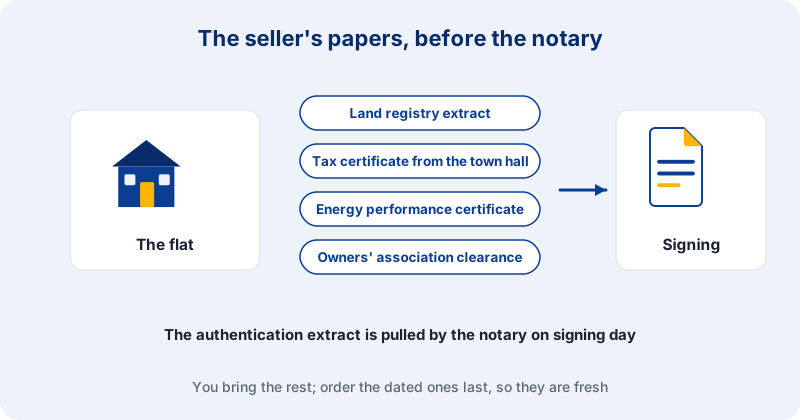
What the seller has to produce
- The title deed: the purchase contract, the donation deed, the inheritance certificate or the court decision through which you acquired the property.
- The cadastral documentation and the land book registration, if the property is not registered yet. An unregistered property cannot be sold until it is.
- The energy performance certificate, issued by an authorised auditor. Without it the notary cannot authenticate the sale.
- The tax clearance certificate from the local council, confirming that local property taxes are paid up to date. It usually takes a few days.
- A statement from the owners' association showing that the shared building costs are settled.
- Identity documents for every owner, plus the marriage certificate or the spouse's consent where the property is jointly owned.
The document that decides whether a buyer trusts you
A careful buyer will order a land registry extract about your property before signing anything, and they do not need your permission to do it. That is worth knowing in advance, because whatever is written in part three of that extract will come up in the negotiation. Old mortgages that were repaid but never removed from the register are the classic case: the debt is gone, the entry is not, and a buyer who sees it assumes the worst. Pull your own extract early and clear anything stale before it becomes a discount.
Selling from abroad
You do not have to fly in. A power of attorney authenticated at a Romanian consulate, or at a foreign notary with an apostille and a certified Romanian translation, lets someone sign in your name. Consular appointments are the slow part, so book that before you agree on a completion date. The same applies to any missing civil status document, which will have to travel.
What happens at the notary
On the day of signing the notary pulls a fresh authentication extract, which blocks the land book while the transaction runs, calculates the notarial fees and the tax you owe on the sale, collects the price transfer confirmation and registers the new owner. The tax on the sale depends on how long you have held the property, so ask the notary for the exact figure on your case rather than trusting a percentage you read somewhere.
A realistic calendar
The energy certificate takes a few days to a week. The tax clearance certificate, a few days. The association statement depends entirely on the building administrator, which in practice means it depends on whether you catch them in the right week. None of these are hard. They are simply sequential, and sellers who start them in parallel with the listing close in two weeks instead of two months.
What the extract actually shows
A land book extract has three parts, and buyers read the third one first. Part one describes the property: cadastral number, surface area as recorded, address, annexes. Part two names the owner and how ownership was acquired. Part three lists everything that burdens the property, from mortgages and seizures to rights of way and lawsuits noted against it. If your part three is empty, say so early; it removes the buyer's main worry in one sentence.
The extract a notary pulls on signing day is a different document from the one anyone can order: only a notary can request it, and doing so freezes the register while the sale is signed. No buyer should be asking you for that one.
The mistake sellers make most often
They start the paperwork after they have a buyer and a signed preliminary contract with a completion date in it. Then the energy certificate takes a week, the building administrator is away, and the deadline meant to protect the seller starts working against them. Preliminary contracts are built so that whoever causes the failure pays for it, and a seller missing a document is the one causing it. Collect the file first, then agree dates you can meet.
Inherited property
If you inherited the flat, the inheritance certificate has to be registered in the land book before you can sell. Until it is, the register still shows the deceased as owner, and a notary will not authenticate a sale from someone who is not in the register. Where there are several heirs, every one of them signs, and an heir living abroad who is slow to answer is the most common reason an inherited flat sits unsold for a year. Finish the succession before you look for a buyer.
Co-owners, spouses and tenants
Everyone who appears as owner signs the deed, and where the property was bought during a marriage the spouse's position has to be settled even if only one name shows in the register. A tenancy does not end because the flat changes hands. If someone is living there, tell the buyer before the offer rather than after it, and put in writing how and when the flat is handed over empty.
Fees, tax and getting paid
The notary calculates the tax on the sale, collects it and pays it over, so you file nothing separately. The notarial fee is a matter of agreement between the parties; the common practice is that the buyer pays it, but write that into the preliminary contract instead of assuming. If the buyer is borrowing, the bank normally releases the money after the mortgage is registered, which leaves a gap of a few days between signature and funds, and the contract should say what happens in that gap. Sellers living outside Romania should warn their own bank in advance: a large incoming transfer attracts questions about its source, easier to answer with the signed deed in hand.
Doing it yourself
None of this needs an agent. The tax clearance certificate comes from your local council, the association statement from the building administrator, the energy certificate from any authorised auditor, and land book extracts come from the cadastre office or online. What you cannot outsource is the sequence, and that is where the delay lives. To see what has been registered and removed on the property over the years, rather than just today's position, order the historical extract.
Common confusions
The cadastral number and the land book number are not the same thing, and quoting one for the other sends the request straight back. Registration in the land book is not the same as having the survey done: the survey produces the documentation, the registration puts you in the register. And an old sale contract on paper does not prove current ownership on its own, because what counts is the register, not the folder in your drawer. The other side of it is covered in buying property in Romania.
Online ordering for this document is temporarily paused while we rework it. The document page has the full details and the alternatives available today.
See document details →