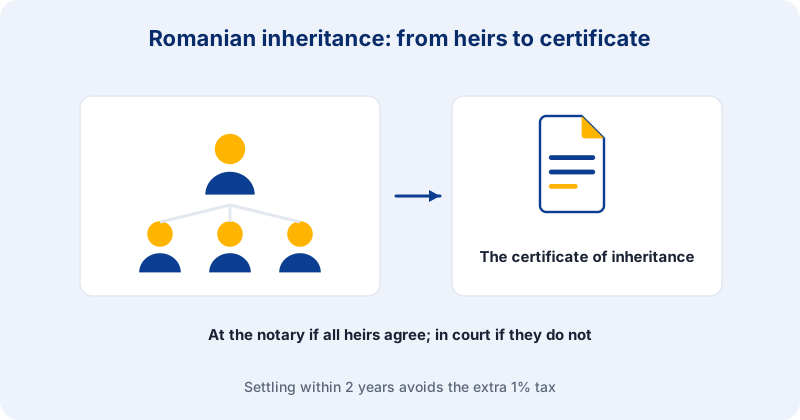
An inheritance in Romania is settled by a notary, not by a court, unless the heirs disagree. The notary opens a succession file, establishes who the heirs are and what the estate contains, then issues the inheritance certificate (certificat de mostenitor). Nothing about the estate can be sold, mortgaged or transferred until that certificate exists. Families discover the document list one piece at a time, usually in the weeks when they have the least patience for offices, so here it is in one place.
The civil status documents
The death certificate, the birth and marriage certificates of every heir, and the deceased's marriage certificate or divorce decision. If a certificate is lost, the civil registry office issues a duplicate. For heirs living abroad this is often the slowest item in the file, because documents issued outside Romania usually need an apostille and a certified translation, so start with it rather than leaving it for the end.
The estate
For property: the title deeds, the cadastral documentation if it exists, and the tax clearance certificate from the local council proving that local taxes are paid. For money and securities: bank statements and contracts. For vehicles: the registration certificate and the vehicle identity card. The notary will also ask for a declaration listing what the estate contains, and an honest inventory here prevents arguments between heirs later, when reopening the file costs everyone money.
The estate includes the debts
An inheritance is not a list of assets. It is a position, assets and liabilities together. Bank loans, unpaid utility bills, arrears on local taxes and guarantees the deceased signed for somebody else all come with it. If the liabilities are heavier than the assets, an heir can renounce, and renunciation is a formal act done at the notary, not a decision announced at a family lunch. It has its own legal deadline, which is worth asking about at the first meeting rather than the last. One practical warning while you are deciding: do not start using the estate. Driving the car, moving into the flat or emptying an account can be treated as acceptance, and acceptance is not something you can take back afterwards.
The part that decides how long it takes: the land book
A current land registry extract shows the property as it stands today, meaning the registered owner and any charges. In succession files notaries frequently ask for the historical extract as well, which lists every owner in sequence and every deed by which the property changed hands. That is the document that resolves the situations everybody dreads: a property that was itself inherited and never properly registered, undivided shares between siblings, an old sale that was signed but never entered in the land book. For anything acquired before the 2000s, expect to need it.
The older succession nobody settled
This is the delay families never plan for. You open the file for a parent, and the land book still shows the property in a grandparent's name, because that succession was never done. The second file cannot be settled over the first. The older one has to be opened, with its own heirs, several of whom have died in the meantime and brought their own heirs into the file. That is the main reason to order the historical extract early rather than when the notary asks for it. It shows you the chain of owners, and if there is a break in it you find out in the first week, before you have gathered ten people for an appointment that cannot go ahead.
Collecting it without repeat trips
Both extracts come from ANCPI. Ordering them through acte-rapide.ro is paused for now, until the ANCPI portal is stable again. The tax clearance certificate comes from the council where the property is located. The civil status documents are usually in the drawer where the deceased kept them, which is the sensible place to start. Book the notary appointment first and ask for their exact list, because offices vary slightly, then collect. Doing it the other way round produces documents nobody needed.
The deadline worth knowing
A succession settled within 2 years of the death is exempt from the 1% tax on the value of the estate. After 2 years the tax applies. This is not a limitation period for the succession itself, which can be opened later, but it is a concrete financial reason not to postpone indefinitely. And if any heir wants to sell in the meantime, they cannot: the inheritance certificate is the gate every later transaction passes through.
Who inherits when there is no will
Most successions in Romania have no will, so the law decides. Heirs are ranked in classes, descendants first, and while there is somebody in the first class the more distant relatives take nothing. The surviving spouse is the exception, inheriting alongside whichever class is present rather than replacing it, with a share that depends on which relatives are in the file. A will can change the distribution, but only within limits, because close heirs are entitled to a reserved portion the testator cannot give away. If you are working out in advance who will have to sign, ask the notary rather than the family. What people repeat at funerals is wrong about as often as it is right.
Heirs who live abroad
You do not all have to be in the same room. An heir abroad can be represented through a power of attorney authenticated at a Romanian consulate, or at a local notary with an apostille and a Romanian translation. An heir can also renounce the inheritance the same way. What none of it survives is silence: a file with an heir who cannot be reached does not progress, so establish contact before booking the appointment.
What the certificate settles, and what it leaves open
The inheritance certificate establishes who the heirs are and what share each of them holds. It does not divide anything. If three siblings inherit a flat, each of them holds an undivided share of the whole flat rather than a room, so any sale means all three signing, unless they go through a separate partition, which is its own act at the notary or, when they disagree, in court. The certificate also does not register itself: for property it has to be entered in the land book before the owner shown there matches the owner in fact. Families that stop at the certificate discover the gap years later, on the day somebody wants to sell or take a mortgage, which is the worst day to discover it.
While the file is open
Accounts in the deceased's name are blocked once the bank learns of the death and are released to the heirs against the certificate, which catches families out when standing orders are still leaving those accounts. The bills carry on regardless. Utilities, building maintenance and local taxes keep accruing, and somebody should keep paying them, because unpaid local taxes come back later as a tax clearance certificate the council will not issue.
Online ordering for this document is temporarily paused while we rework it. The document page has the full details and the alternatives available today.
See document details →