Of all the ways buying a used car can go wrong, this is the quietest. The car looks immaculate, the documents seem in order, the price is fair, and a year later you learn that somebody else's bank has rights over it, because the previous owner pledged it against a loan he stopped paying. The pledge follows the car, not the person. You bought the debt along with the vehicle.
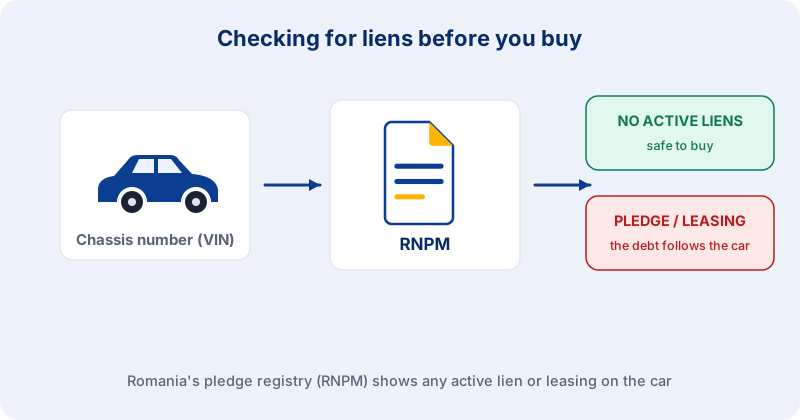
Where the debts are written down
The Romanian National Register of Movable Publicity (RNPM) is the official record of security interests over movable assets: bank pledges, running leasing contracts, movable mortgages. The legal rule is short and merciless. Anything registered in the RNPM is enforceable against everybody, which means you cannot defend yourself by saying you did not know. The law considers that you could have checked. That is why this check is not excessive caution; it is the only real defence there is.
Leasing and pledge are not the same problem
People use the two words as if they described one situation. In a financial leasing contract the finance company remains the owner of the car until the last instalment and the buyout are paid, so the man driving it has possession and nothing else. He cannot sell it, whatever he tells you and whatever discount he offers for cash. A pledge is different. The borrower genuinely owns the car, but a creditor holds a registered claim over it, and that claim travels with the vehicle when it changes hands. In the first case the sale is not the seller's to make. In the second it is, and you inherit the debt attached to it. Both are recorded in the same register, which is why one search answers both questions.
The signs that should send you straight to the register
A seller in a suspicious hurry. A car bought recently and already back on the market. A price visibly under the market with no technical explanation. A vehicle identity card that is currently at the bank or at the company. Each of these has an innocent explanation, and each of them also has the same guilty one: the car is not free of charges.
How the check works
The register can be searched at rnpm.ro, and the public search is free. It is also built for lawyers. You have to know which criteria to search by, and the results come back in the language of registration notices, from which an ordinary buyer struggles to tell whether the car is encumbered or not. On acte-rapide.ro you enter the VIN, or the seller's personal or company identification number if you want to see everything registered against them, and receive a plain-language report. This service is paused for now and will be back soon; until then the free public search on rnpm.ro is the way to check.
Search the car, then search the seller
Most buyers search the VIN, see nothing, and stop. The VIN is the right place to start, but registrations are filed against the debtor as well, and a notice can describe assets in terms wider than a single chassis number. If the seller is a company, searching its registration number shows what has been filed against the business as a whole, which is how you find out that the van you are about to buy sits inside a general charge over the company's assets. If the seller is a private person, the personal identification number does the same job. The two searches take the same few minutes and they do not answer the same question.
What the report does not cover
An RNPM search answers one narrow question: whether a security interest has been registered. It says nothing about mileage, accident history, whether the engine has been replaced, or whether the person holding the keys is the owner on the registration certificate. It is not a check on unpaid fines and not a statement about the technical condition of the car. Buyers occasionally come back with a clean RNPM result and treat it as a certificate of general health for the vehicle. It is not that document, and on its own it will not save a bad purchase.
What to do if something comes up
An active pledge does not automatically end the deal. Cars are sold out of leasing and out of bank pledges every day, but the sequence has to be right: the debt is settled and the registration removed before the money for the car changes hands, with the creditor's written confirmation in your hands. A seller who suggests you pay first and trust that the entry will be cleared afterwards is asking you to fund the settlement of somebody else's loan with no guarantee attached.
Run it again on the day you pay
An entry can be made in the register at any time, including the week you spend negotiating. A search you ran a fortnight ago describes the register as it stood a fortnight ago. On a car worth real money, search once when you decide to buy and once more on the morning the money moves, then keep the second report with the sale contract. The repeat search costs the same as the first and fixes the state of the register at the moment of payment, the only moment that matters if there is an argument later.
What it looks like when the creditor turns up
The unpleasant part of these cases is not the phone call from the bank. It is where the call leaves you. The creditor enforces against the car, because registration made the claim good against everybody, and your remedy runs against the seller, who by then has spent the money and is frequently not at the address written on the contract. You end up paying a lawyer to chase a sum somebody else already used, while the car sits somewhere you cannot reach it. That imbalance is the whole argument for a check that takes under an hour.
The complete check before the money moves
The RNPM shows debts, not kilometres and not accident history. A full check on a used car has three parts: the RAR history for mileage and damage (we wrote about how to read it), an international VIN report for imported cars, and the RNPM for charges. All three together cost under 300 RON, which is well under one percent of the price of an ordinary car, and all three are done from home with the VIN taken from the advert.
Before you hand over the deposit
The full price is rarely the money that gets lost. The deposit is, because a deposit is what a seller asks for while the checks are still pending, on the grounds that another buyer is coming this evening. Do the search before the deposit, not before the signature. A seller with nothing registered against him will wait an hour for a report while you sit in his kitchen. A seller who cannot spare that hour has told you what the hurry is for. For the rest of the checks, see the full routine for buying a used car in Romania.
Online ordering for this document is temporarily paused while we rework it. The document page has the full details and the alternatives available today.
See document details →