An apostille is the standard certificate under the 1961 Hague Convention that makes a public document from one member country legally usable in another. For a Romanian criminal record certificate (cazier judiciar), the apostille is issued by the prefecture (Instituția Prefectului), the government's county office, and it confirms to the foreign authority that the Romanian document and its signature are genuine. Whether you actually need one depends on where the certificate is going, and that is worth checking before you spend a day on it.
First check: you may not need an apostille at all
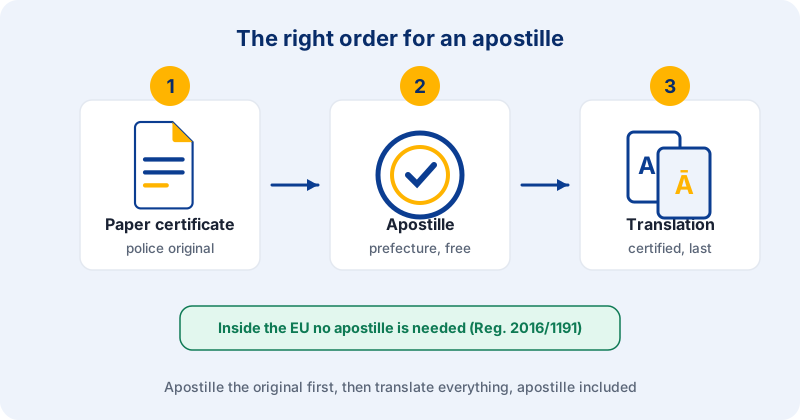
Inside the European Union, Regulation 2016/1191 exempts several categories of public documents from apostille requirements, and the certificate of absence of a criminal record is expressly one of them. An EU authority asking for your Romanian cazier should accept it without an apostille, and can ask ONRC-style multilingual standard forms instead of a certified translation. In practice some clerks still ask for apostilles out of habit; pointing to the regulation usually settles it. Outside the EU, the question is whether the destination country is a member of the Hague Convention: most are, and then the apostille is the way. For the few that are not, the older and slower route of consular super-legalisation applies, and the receiving institution will tell you so.
Where and how the apostille is issued
For administrative documents like the criminal record certificate, apostilles in Romania are issued by the prefecture of the county where the document holder lives or where the document was issued. The procedure is same-day or next-day in most counties, and since 2017 the apostille itself is free of charge, after Romania scrapped the old extra-judicial stamp taxes. You bring the original certificate, an identity document, and a simple request form; a proxy can do it for you with a power of attorney.
The paper problem with online certificates
Romania issues criminal record certificates electronically, signed with a qualified electronic signature, through hub.mai.gov.ro. That version is legally equivalent in Romania, but an apostille is a physical certificate attached to a physical document, and prefectures apostille paper originals issued by the police. If your destination requires an apostille, plan for the paper certificate from the start: request it at a police station in Romania, through a Romanian consulate, or through a proxy with power of attorney. If the destination accepts electronically signed documents, the online certificate may spare you the whole chain. Ask them first, in writing.
Translation: after the apostille, not before
Most foreign institutions want the certificate translated by a certified translator. The order matters: first the apostille on the Romanian original, then the certified translation of everything, apostille included. Some countries additionally want the translator's signature notarised and that notarisation apostilled too; that second apostille goes through the chamber of notaries, not the prefecture. It sounds baroque because it is; the receiving institution's checklist is the only authority worth following on this.
Timing the whole chain
The certificate itself is valid for six months, but foreign institutions usually want it recent, so count backwards from your submission date: certificate first (minutes online, days on paper through a proxy), apostille next (a day), translation last (a few days). Our criminal record assistance service handles the Romanian end of that chain in English; the apostille step itself stays with the prefecture, and no private service can skip it.
Who ends up needing one
The usual cases are a job offer abroad that comes with a background check, a residence or work permit application, a citizenship or naturalisation file, adoption and foster care procedures, enrolment at a foreign university, and registration with a professional body such as a medical or nursing council. What these share is that a foreign officer has to trust a Romanian signature they have never seen. The apostille is the shortcut that spares them from verifying it themselves.
If you already live abroad, the certificate can be requested through a Romanian consulate or by a proxy holding a power of attorney, as our guide on getting a Romanian criminal record from abroad explains. The apostille then falls to the same proxy, since the prefecture works on the paper document.
What an apostille does not do
It does not translate anything. It does not confirm that the content of the certificate is true, only that the signature and seal are genuine and that the person who signed had authority to do so. It does not extend the certificate's validity either: an apostilled certificate ages at exactly the same rate as a plain one. And it is fixed to one physical copy, not to photocopies made from it afterwards.
The mistakes that cost a repeat trip
Translating first is the most common. A translation produced before the apostille cannot contain the apostille text, and most institutions want the whole document rendered into their language, so you pay the translator twice for the same page.
Apostilling a copy is the second. Prefectures work on originals issued by the authority, not on photocopies, however neatly certified those copies are.
Going to the wrong office is the third. Romania splits this work by document type: administrative documents such as the criminal record certificate go through the prefectures, while documents issued by courts and documents that have passed through a notary follow their own channels. Arriving at the prefecture with a notarised translation and asking for a single apostille on the whole bundle produces a polite refusal and a wasted morning.
The fourth is bringing the electronically issued certificate on paper and expecting a stamp on it, for the reason set out above. It is the newest of the four and currently the most frequent.
Three questions to ask the receiving institution
Ask them by email and keep the reply. First: do you accept a Romanian criminal record certificate without an apostille? Inside the EU the answer should be yes, and having it in writing settles any argument at the counter. Second: do you accept the electronically signed version, or do you require a paper original? Third: who must produce the translation, a translator certified in Romania or one certified in your country, and does the translator's signature need notarisation? Those three answers determine the entire chain, and cost one email against the days you lose by guessing wrong.
If the destination is not a Hague member
Then the document is certified in sequence rather than in one step: by the Romanian authority competent for that type of document, then by the Romanian foreign ministry, then by the destination country's embassy in Romania. Each stage has its own queue, and the embassy stage usually sets the overall pace. If the institution asking for your file cannot tell you which of the two routes applies, their own foreign ministry or the embassy handling your case can.
One certificate, several uses
If the same document is needed for two purposes at once, typically an employer and an immigration office, decide that at the start. Two paper originals requested in one go cost one trip and can both be apostilled, whereas discovering later that the only apostilled original sits in someone else's file means repeating the whole chain.
Online ordering for this document is temporarily paused while we rework it. The document page has the full details and the alternatives available today.
See document details →