The cazier judiciar is Romania's official criminal record certificate, issued by the Romanian Police and valid for six months. You need one and you are in London, Chicago or Sydney. Maybe you are applying for citizenship somewhere, maybe an employer wants proof of a clean record covering the years you lived in Romania, maybe it is for a professional licence. The certificate itself is a one-page document the Romanian police can issue in minutes. The distance is the entire problem, and there are three realistic ways around it.
What the certificate is
It states whether you have entries in the Romanian criminal record, carries the issuing institution's signature and stays valid for 6 months. Foreign authorities almost always want it recent, so do not order it months before your application; time it for when the receiving institution will actually look at it.
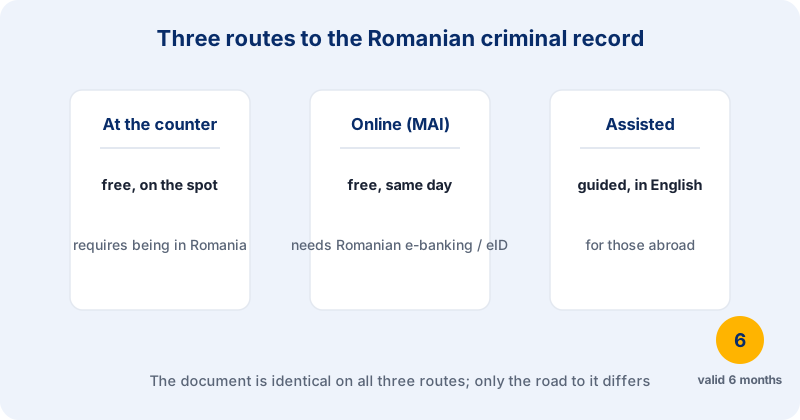
Route one: the Romanian consulate
Consulates can process criminal record requests. The catch is throughput. In cities with large Romanian communities, appointment slots are booked weeks or months out, and after the appointment the request still travels to Romania and back. If your deadline is next quarter, this route works and costs little. If your deadline is this month, look elsewhere.
Route two: the official online platform
Since a few years ago, hub.mai.gov.ro issues criminal record certificates online, free, often the same day, with a qualified electronic signature. It is the best deal in Romanian e-government, and we say that as a company that charges for the alternative. The conditions filter people out fast, though: the platform exists only in Romanian, it requires either a Ghișeul.ro account with an enrolled Romanian bank card or Romanian electronic identification, and the request form makes you pick the reason for the certificate from an official list of over 200 Romanian entries, where the wrong pick means a certificate your destination may reject. If you left Romania years ago and have no active Romanian banking, you may find you cannot even create the account.
Route three: assisted, with us
This is where we come in, and it is worth being precise about what you are buying. You fill in a form in English; we prepare a correctly completed request, translate the reason you need into the right entry from that 200-item Romanian list, send you the exact steps and stay on email while you go through them. You validate the request yourself, from your own account, because Romanian law requires the request to come from the holder. That requirement is not bureaucratic decoration: it is precisely what stops anyone pulling your criminal record without your knowledge. If you cannot authenticate online at all, we send you the power-of-attorney route instead, which Romanian law also allows. This assistance service is paused for now and will be back soon. The document itself is free.
What the certificate does not do
It reports what the Romanian record holds and nothing else. If you have lived in three countries, a clean Romanian certificate says nothing about the other two, and the institution reading your file will usually want one from each country you lived in. It is not a character reference, it does not show unpaid debts, civil judgments or tax arrears, and it proves nothing about your address. Requests reach us from people hoping the certificate will settle an argument with a former employer or a landlord. It will not.
Names that changed along the way
The search runs against Romanian civil status data, so the certificate comes out in the name Romania has on file. If you married abroad and your passport now carries a different surname, the two documents will not match, and whoever reviews your file will ask how they connect. Send the marriage certificate with it and say so upfront rather than letting a clerk discover the discrepancy.
Spelling causes the same trouble in a quieter way. Romanian documents carry diacritics that foreign systems drop or replace, so a surname can appear one way at home and another abroad. Tell us the exact spelling on the document you will submit it alongside, and we will flag the difference before it becomes a rejection.
Three documents that sound alike
The cazier judiciar is the criminal record, held by the police. The cazier fiscal is a tax record held by ANAF, about tax and accounting offences, and it is normally asked for when someone sets up a company or takes over as director. The certificate of behavioural integrity is a separate document required for work involving children. Employers and lawyers abroad often ask for one by the name of another, and the wrong document means starting over. If the wording on your form is ambiguous, ask the institution which of the three it means before you order anything.
Two details that save applications
First, the CNP. Requests are matched by the Romanian personal numeric code. If you ever had Romanian documents, you have one, even if you emigrated as a child; it is printed on old identity papers and birth certificates. If you genuinely never had one, write to us before ordering and we will tell you what your case needs. Second, the destination country. Certificates used abroad often need an apostille, sometimes a certified translation on top. Both happen after issuance and add days, so ask the institution receiving your file what exactly they expect, then count backwards from your deadline.
Planning backwards from the deadline
The six-month validity is the outer limit, not the rule you plan around. The institution reading your file may apply a shorter freshness rule of its own, and theirs is the clock that counts, so ask them in writing how recent they need it and keep the answer.
Then work backwards from the date your file is actually reviewed: subtract the time an apostille and a sworn translation take, then the time your chosen route takes. Order too early and it expires inside the folder; order too late and the consulate appointment lands after your deadline.
One more scheduling note if several documents go into the same application. Birth certificates and diplomas do not expire, while the criminal record does, so it is usually the shortest-lived paper in the folder. Get it last, once everything else is ready, and you avoid paying for the same document twice.
Online ordering for this document is temporarily paused while we rework it. The document page has the full details and the alternatives available today.
See document details →