Romanian property is cheap by Western European standards, and that attracts buyers who have never dealt with a Romanian notary, a land book or a seller whose paperwork lives in a folder from 1994. The good news: ownership records here are centralised and reliable. The land registry (cartea funciară) tells you exactly who owns a property and what debts sit on it. The bad news: every official channel for reading those records runs in Romanian only. This guide covers what to check and how, before any money leaves your account.
Can you buy at all?
If you are an EU or EEA citizen, yes, on the same terms as a Romanian, land included. If you are from outside the EU, you can own buildings but not land directly; the usual solutions are buying through a Romanian company or checking whether a bilateral treaty between Romania and your country applies. An apartment purchase is simpler in practice than buying a house with a garden, because of that land question. Whatever your situation, put it to the notary before you commit to anything. Notaries in Romania are neutral state-licensed officials, not the seller's representative, and the transaction cannot close without one.
The land registry is the only truth that matters
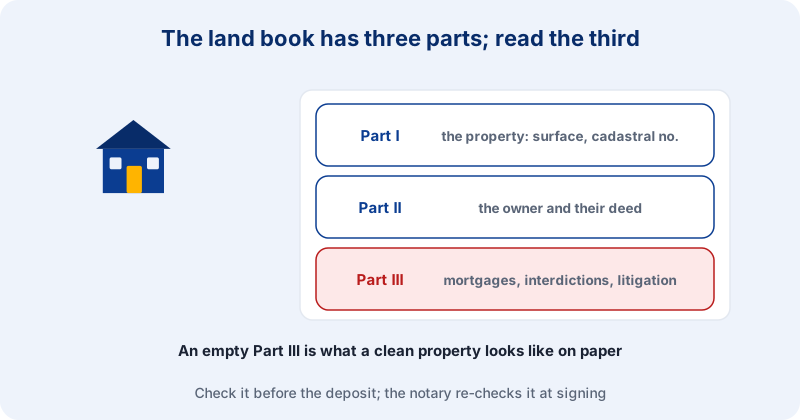
Verbal assurances, old contracts, even utility bills in the seller's name prove nothing. Romanian law recognises the person written in the land book. The land registry extract (extras de carte funciară) has three parts: the description of the property with its surface and cadastral number, the current owner and the deed they acquired it under, and, the part that saves buyers, the charges. Mortgages, seizure orders, rights of use held by third parties, pending litigation. All of it is noted there, and none of it disappears just because the seller forgot to mention it.
What to look for in the extract
Check that the owner's name matches the person selling to you, exactly. Check part III for any mortgage: buying a mortgaged property is possible but needs the bank's involvement at the notary. Check for interdictions, which block sales entirely, and for noted litigation, which means someone else claims rights over the property. An inheritance dispute noted in the land book can outlive the seller, the notary and your patience. If part III is empty, you are looking at a clean property.
The boundaries problem, for land and houses
For apartments the surface in the land book is usually the end of the story. For land, what is fenced and what is registered can be two different shapes. The cadastral plan extract shows the official boundaries drawn on aerial photography, so you can see whether the neighbour's fence, the access road or half the orchard actually belongs to the plot you are paying for. Sellers rarely lie about this on purpose; boundaries in older villages drifted for decades before anyone measured them.
How you actually get the documents
The official channel is the ANCPI e-payment platform. It works, and the state fee is around 20-25 lei, but the site is in Romanian, requires an account, and expects you to already know the exact land book or cadastral number. There is no search by address. Ordering the extract through acte-rapide.ro is paused for now, until the ANCPI portal is stable again; the page for the extract will say when it is back. For a purchase of tens or hundreds of thousands of euros, either route is worth it. Just make sure someone reads the extract before your deposit moves.
The process after the check
A typical purchase runs: verbal agreement, pre-contract with a deposit signed at a notary, then the final deed a few weeks or months later. For the final signing the notary pulls a fresh authentication extract themselves, which freezes the land book during the transaction. Your extract, ordered before the pre-contract, is the one that decides whether you should be at that table at all.
Online ordering for this document is temporarily paused while we rework it. The document page has the full details and the alternatives available today.
See document details →