79 RON (about €16), by email in ~10 minutes, electronically signed
Every year, foreign companies wire advance payments to Romanian partners they found online and never met. Most of those deals go fine. The ones that go wrong usually failed a ten-minute check that costs less than a restaurant lunch. Romania keeps detailed, public, legally binding records about every registered company; you just have to pull them before signing instead of after.
Start with the Trade Register certificate
The certificat constatator, issued by the National Trade Register Office (ONRC), is the company's official identity sheet: registered name and tax ID, address, who the shareholders and directors are, what activities it is licensed for, its share capital and, most usefully, its current status. A company can look alive online while being suspended, in insolvency proceedings or struck off entirely. The certificate settles that in one line.
How to read it like a sceptic
A few patterns deserve a pause. A company registered three months ago negotiating a six-figure contract. A sole director who replaced the previous one last week, right before your deal. Share capital of 200 lei behind promises of industrial-scale delivery. An address that turns out to host forty other firms in the same two-room apartment. None of these proves bad faith on its own; new companies have to start somewhere. Together with pressure to pay in advance, they form a picture.
Find out who is actually behind it
Shareholders listed in the certificate can themselves be companies, sometimes stacked two or three layers deep. The ultimate beneficial owner extract, from the same Trade Register, names the physical persons who ultimately own or control the firm. Banks pull it for anti-money-laundering checks. If your counterparty's ownership chain ends with a person nobody can find on any public record, you have learned something worth knowing before the wire transfer, not after.
Debts to the state
The tax clearance certificate from ANAF, the Romanian tax authority, shows whether the company owes money to the state budget. A partner drowning in unpaid VAT tends to treat your advance payment as oxygen. For serious contracts, ask them to provide this certificate themselves; a healthy company can produce it within a day, and a refusal is an answer in itself.
Free sources and their limits
Romanian websites like listafirme.ro show fragments of this data at no cost, and for a first impression they are fine. What they give you is unofficial, sometimes stale, and worthless in a dispute. For a fast screening with a verdict, our 60-second company check aggregates the tax authority data with court cases for 39 RON, about the price of a quick lunch. The official certificate carries ONRC's electronic signature and holds up in court and in front of banks. Getting it directly from ONRC requires an account on a Romanian-language portal and the official fee; through acte-rapide.ro you order in English with just the company's tax ID and the signed original arrives by email in about 10 minutes, for 79 RON, at any hour. Which route you take matters less than taking one of them before the contract is signed rather than after the money is gone.
What the certificate does not cover
The certificate is an identity document, not a financial statement. It will not tell you what the company earned last year, whether it pays suppliers on time, or whether three former clients are suing it. Those facts live in other registers. Treat it as the first filter: it removes the companies that do not legally exist in the form they claim, which is a larger group than most people expect, and leaves you to check the rest.
Annual accounts are public too
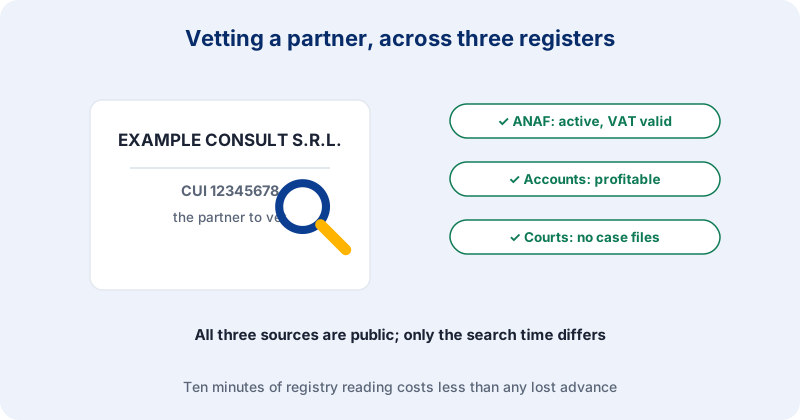
Romanian companies file annual financial statements with the Ministry of Finance, and anyone can look them up by tax ID at no cost. You get turnover, profit or loss, equity, debts and headcount, year by year. Read several years rather than the latest one; a turnover falling by two thirds over two years says more than any single figure. The catch is timing. Filings arrive months after the financial year ends, so for much of the calendar the newest public numbers describe a period that is already well behind. The balance sheet shows direction, not the current state.
Court records
Court files are published on a public portal and can be searched by party name. You can see whether your counterparty is a regular defendant in payment disputes, whether it is the one chasing its own debtors, and whether an insolvency file has been opened against it. Company names repeat and homonyms are frequent, so match each file against the registered name and the county before drawing conclusions.
VAT status
A Romanian company can have its VAT registration cancelled by the tax authority, usually after returns stop being filed. If your counterparty keeps issuing invoices with a VAT number that no longer works, you find out at your own accountant's expense. For cross-border trade, the EU VIES system confirms whether a Romanian VAT number is valid for intra-community transactions. It confirms the number, not the health of the business behind it.
Two identifiers people mix up
Every Romanian company has a tax identification code, the CUI, and a Trade Register number starting with J that encodes the county. Suppliers quote one or the other, occasionally an outdated one from before a name change. The tax ID is the stable key, so use it for every search. Searching by company name alone is how people end up checking a different firm with a similar name and feeling reassured about the wrong company.
When to run the check
Before the advance payment, not before the final invoice. Before signing a framework contract, and again before renewing it, because a supplier that was solid two years ago may have changed owners since. Also when something small goes wrong: a delayed delivery combined with a sudden request to pay into a different bank account is worth ten minutes of register work before you transfer anything.
What you need in order to check
The tax ID, and nothing else. No power of attorney, no existing relationship with the company, no Romanian entity of your own. These are public records and the company is not told that someone looked. If all you have is a trade name and a website, the tax ID normally appears in the site footer, in the terms and conditions, and on every invoice they issue.
If the check comes back bad
Nothing here obliges you to walk away. It tells you what to negotiate. A young company with thin capital can still be a good supplier if you pay on delivery instead of in advance, split the order into stages, or ask for a guarantee from the shareholder personally. A company in insolvency is a different matter, because payments and contracts are handled by an administrator and your invoice joins a queue. The point of the ten minutes is to price the risk before you accept it, not to find a perfect counterparty.
Fill in a form, pay online and receive the electronically signed document by email.
Order a company registration certificate (79 RON, ~10 minutes) →