89 RON (about €17), by email in ~10 minutes, electronically signed
The Romanian used car market runs on optimism. Odometers show what buyers want to see, service books lose exactly the inconvenient pages, and a car described as owned by a careful doctor may have spent four years as an airport taxi in another country. None of this survives contact with the actual records, which is why the records are the first place to look.
The official memory of every car in Romania
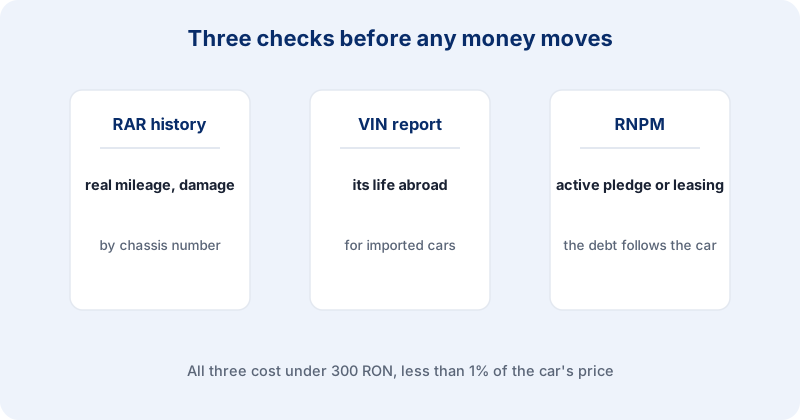
At every periodic technical inspection (ITP), the odometer reading goes into the database of the Romanian Automotive Register (RAR). Insurers report damage into the same system. That means any car with a few years of Romanian history has an official mileage curve nobody can edit retroactively. A normal car gains 10,000 to 20,000 km a year. If the readings ran 180,000 in 2022, 210,000 in 2024, and the dashboard in front of you says 149,000, the negotiation is over before the test drive.
Read the curve, not the last number
The useful part of the RAR record is its shape. A car that gained a steady 15,000 km a year and then, between two inspections, gained two thousand, was either parked for a year or was not really parked at all. Gaps count as well: a stretch with no inspection usually means the car was off the road, and it is fair to ask why. Then compare the record against the object in front of you. A car with modest recorded mileage, worn pedal rubbers, a polished steering wheel and a collapsed bolster on the driver's seat is telling you something the dashboard is not, and the dashboard is the part that can be rewritten in twenty minutes.
How to get the RAR history
You need one thing: the VIN, the 17-character chassis number on the registration certificate and usually at the bottom of the windscreen. Ask the seller for it; a refusal tells you plenty. RAR issues its official certificate, called RAR Auto-Pass, on its own platform, in Romanian, paid by card. Through acte-rapide.ro the same official data comes at 89 RON with the form in English and the report in your inbox in about 10 minutes. Either way, the check costs a rounding error next to the car.
What the RAR history will not tell you
It records what was reported to it. Damage repaired for cash at a small workshop, with no insurance claim behind it, leaves no trace. Neither does anything that happened between two inspections, nor anything that happened before the car arrived in Romania. A clean history is a good sign rather than a guarantee, and it does not replace an hour on a lift with a mechanic who has no stake in the sale. Treat it as the document that catches the lies, not as the document that certifies the truth.
Imported cars are the blind spot
Romania imports used cars by the hundreds of thousands, mostly from Germany, France and Belgium. The RAR database sees a car's life only from its first Romanian inspection onward, and the years abroad are exactly where rolled-back odometers and repaired crash damage hide. For any recently imported car, an international VIN report is the tool that fills the gap: it queries damage databases, historical mileage records, theft registers and fleet-use markers across countries. On a freshly imported car with a suspiciously smooth story, skipping this check is how people buy someone else's write-off.
The car may not even be the seller's to sell
Cars under leasing contracts or pledged as loan collateral appear in the Romanian national pledge registry (RNPM); an RNPM check shows any active registrations before you pay. Buy one and the finance company's claim follows the car, not the seller. Also compare the name on the registration papers with the ID of the person in front of you: a middleman selling a friend's car with no power of attorney will be unreachable the day a problem surfaces.
The papers, and the person holding them
Before any money moves, put the registration certificate, the vehicle identity card and the seller's ID on the table at the same time and read the names on all three. If the person selling is not the owner named on the papers, you need a power of attorney, and a photograph of one on a phone is not a power of attorney. Check the VIN stamped on the body against the papers character by character, because a mismatch there turns up in two situations only, stolen cars and cars rebuilt from two wrecks. Check the ITP validity and agree what happens to the plates. And if the seller cannot produce the vehicle identity card because it is at a bank or at a leasing company, you have just learned the most important fact of the day.
A twenty-minute routine before any money moves
Get the VIN from the listing or the seller. Pull the RAR history, and the international report if the car was imported in the last few years. Match the VIN stamped on the body against the papers, character by character. Then, if the records agree with the story, pay a service of your choosing for an hour on a lift. Sellers with nothing to hide accept all of this calmly. The other kind gets creative with reasons why there is no time, and that reaction is itself the cheapest diagnostic on this list.
Trader or private seller
A car bought from a registered trader is a consumer purchase and carries the guarantees that go with one. Buying from a private individual is a different position: the seller is still answerable for defects he concealed, but proving what he knew, and finding him a year later, becomes your problem. This is not an argument for one over the other, since private sellers are cheaper for precisely this reason. It is an argument for spending more on checks when the seller is a private person, because afterwards there is nobody to go back to.
Why the checks are worth more than the discount
Buyers negotiate hard over a few hundred lei on the price and then skip a report that costs less than the fuel spent driving to see the car. The reports are also the only leverage in the room that is not an opinion. A recorded mileage that contradicts the dashboard, or an active entry in the pledge register, changes the price or ends the conversation, and neither of those is something the seller can argue with. Ask for the VIN in the first message you send about a listing. The sellers who give it immediately are the ones worth driving to.
Fill in a form, pay online and receive the electronically signed document by email.
Order a RAR vehicle history report (89 RON, ~10 minutes) →