39 RON (about €8), by email in ~60 seconds, electronically signed
Romania keeps unusually detailed public records about its companies: tax status, three years of financial statements, every court case the company is a party to. The catch is that all of it is published in Romanian, on separate state websites, in vocabulary that even locals find opaque. If you are about to wire money to a Romanian supplier, these are the terms you will run into and what each one actually tells you.
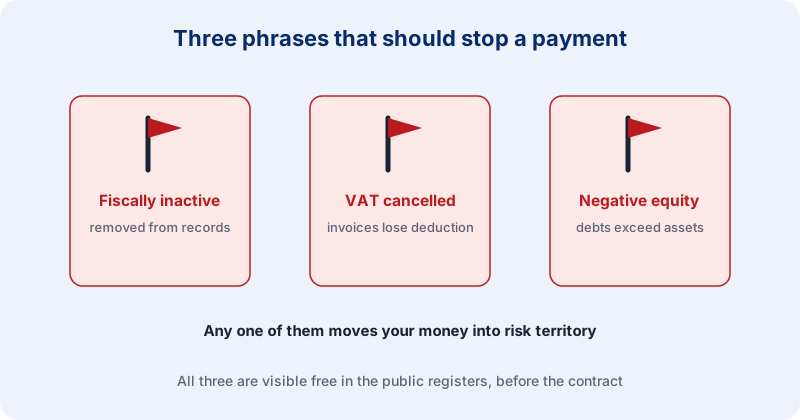
Fiscally inactive: the most common flag and the most misread
A company declared fiscally inactive (inactiv fiscal) by ANAF, the Romanian tax authority, has not necessarily stopped trading. The status usually means it failed to file tax returns, could not be found at its registered address, or has problems with its directors. The practical consequence sits on your side of the deal: invoices from a fiscally inactive company are not tax deductible for the payer, which is why Romanian accountants check this status before booking any invoice. Companies can be reactivated after fixing their situation, so the date matters. An inactivation from three years ago tells a different story than one from last month.
Cancelled VAT registration
Romanian companies lose their VAT code for reasons that range from harmless to serious. Dropping below the registration threshold or cancelling voluntarily is routine administration. Cancellation for fiscal inactivity or for what ANAF calls high fiscal risk is different: the tax authority has formally decided the company is a risk, and that decision is visible in the public record as a single line. A separate check worth doing for cross-border trade is VIES, the European Commission's registry. If the company's VAT number is not valid there, your intra-community invoicing will not work the way your accountant expects.
A loss in the annual statement is not automatically a disaster
Romanian companies file annual financial statements that become public, so you can see turnover, profit and debts for the last three years. One loss-making year at an otherwise solid company often just means investment: new equipment, a second location, hiring ahead of growth. The serious pattern is repeated losses combined with growing debts. That is not a company investing in its future, that is a company slowly sinking, and its unpaid suppliers will eventually include whoever signed the most recent contract.
Negative equity: the company owes more than it owns
Equity (capitaluri proprii) is what remains of a company's assets after subtracting its debts. When the figure turns negative, creditors are queuing for a pie that does not exist. Romanian company law requires shareholders to restore the capital in this situation, but plenty of firms carry on for years regardless. The rule of thumb Romanian businesses use among themselves applies to you too: no advance payments to a company with negative equity. Short payment terms, guarantees, or a polite no.
Court records: the company's role matters more than the count
Every Romanian court case is searchable by party name, which is remarkable transparency by European standards. The number of cases alone means little until you look at which side the company was on. A firm suing non-paying customers appears as claimant and is defending its money, which if anything signals discipline. A firm repeatedly sued by suppliers and employees appears as defendant, and that pattern deserves your attention, because someone was left unpaid before you came along. Insolvency and bankruptcy cases are their own category: a single one changes the entire conversation, since any claim you have would join a queue behind the state and the banks.
No financial statements on file
Statements for a given year are filed the following year, so a company founded a few months ago legitimately has nothing published. A five-year-old company with no statements has simply not filed them, which is a fineable offence in Romania, not an oversight. The same logic applies to a company reporting zero turnover while telling you business is booming: either the records are wrong or the story is.
Checking all of this at once
Everything above is public and free, spread across the tax authority, the finance ministry and the courts portal, all in Romanian. If you read the language and have a spare hour, you can collect it yourself. The short route is the instant company check on acte-rapide.ro: enter the tax ID, pay 39 RON (about 8 euros), and the PDF report arrives in about a minute with every signal above already interpreted, a colour-coded verdict and a 0-100 trust score, in English-friendly formatting. If the company passes and the contract is serious, follow up with the official Trade Register certificate, which also shows who actually owns the company.
Fill in a form, pay online and receive the electronically signed document by email.
Check any Romanian company instantly (39 RON, ~60 seconds) →