If you are taking a job at a school, a kindergarten, a children's sports club or as a nanny in Romania, your employer will ask for a document many people hear about for the first time at that moment: the certificat de integritate comportamentala, the certificate of behavioural integrity. It is not the criminal record certificate, although it looks similar, and the confusion between the two sends hiring files back every week.
What it certifies
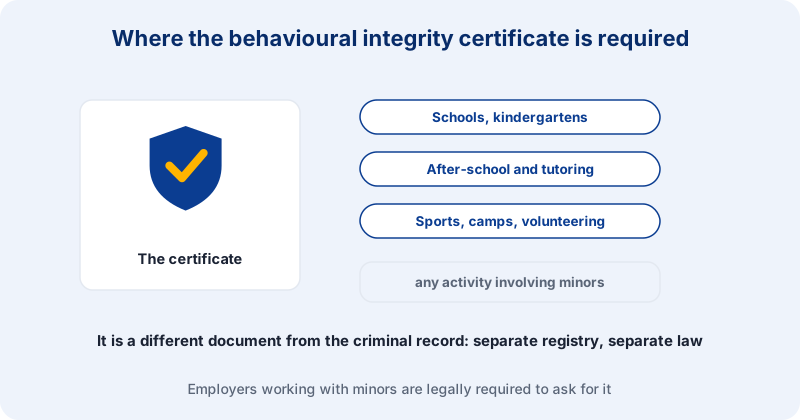
The certificate states whether you appear in the national register of persons who have committed sexual offences, offences of exploitation or offences against minors, a register created by Law 118/2019. Employers whose staff work with children have a legal obligation to ask for it, and the penalties for hiring without it are severe enough that nobody makes exceptions. Beyond employment, it is also requested from volunteers in camps and NGOs, from medical staff in paediatric wards and from parents accompanying groups of children.
How it differs from the criminal record certificate
The criminal record certificate (cazier judiciar) covers all criminal offences. The integrity certificate checks one register only, the one for sexual offences and offences against minors, and entries stay there after rehabilitation, for longer than they remain in the criminal record. That is why institutions in education normally ask for both, as two separate documents. If you were asked for both, you need two certificates, not one.
The counter route
The certificate is issued at any police criminal-record counter in the country, on presentation of an identity document, regardless of where you live. You normally receive it on the spot. What it costs you is the journey, the opening hours and the queue on the day, which is manageable if you live near a counter and out of reach if you live abroad.
The online route, since July 2026
Since July 2026 the certificate can also be requested online, through hub.mai.gov.ro. Authentication is personal: ROeID, an electronic identity card, or a Ghiseul.ro account with an enrolled Romanian bank card, where the card only confirms who you are and no payment is taken. Anyone holding one of those receives the certificate electronically signed, usually within minutes. The catch sits in the requirements: all three are Romanian identity instruments, and the interface is in Romanian throughout.
What it does not cover
The certificate answers one question about one register. It says nothing about traffic fines, unpaid debts, civil disputes or how a previous job ended, and it is not a general background check. It does not confirm your qualifications either, which some employers quietly assume it does. If a hiring file needs a broader picture, that comes from other documents, and asking which ones at the start saves a second round of paperwork.
If you have lived abroad
The Romanian certificate reflects the Romanian register and nothing else. Employers in education often ask people who have worked in another country for the equivalent document from that country's authorities, sometimes translated and legalised. Start that part early. Foreign certificates arrive on foreign timescales, and in practice it is the piece that holds hiring files up longest.
The format the employer will accept
Requested online, the certificate arrives as a PDF carrying an electronic signature. The signature is what proves the document and it exists only inside the file, so send the PDF itself rather than a photograph of a printout. Some employers still want paper for the personnel file. Ask which they need before you go looking for a printer, and if they insist on a stamped paper original, the counter route gives you exactly that.
If something appears in the register
The certificate reports what the register holds; it decides nothing by itself. If the content looks wrong to you, the correction is made with the authority that keeps the record, not with the employer, and it is worth taking legal advice before you submit a file you already know will come back with an entry on it.
Who may request it
You, and nobody else on your behalf without a mandate. An employer cannot pull your record from the register directly, which is why every route above begins with your identity rather than the company's. What the employer receives is the document you hand over. Anyone offering to obtain the certificate without you signing or authenticating anything should worry you rather than reassure you.
Where we come in
On acte-rapide.ro you fill in a form that takes two minutes, and we prepare a correctly completed request and send you the exact steps. You validate it yourself, from your own account, because the law requires the request to come from the holder. That requirement is what stops a stranger pulling your record without your knowledge. If you get stuck, you reply to the email and we take it from there, and if you cannot authenticate online at all, we send you the power-of-attorney route instead. This assistance service is paused for now and will be back soon. The document itself is free at the police. It makes sense for people who cannot reach a counter or cannot get through the Romanian-language platforms, and for nobody else.
Validity, and a timing tip
The certificate is valid for 6 months from issue. Employers usually want a recent one, so do not pull it months before the interview. The efficient move is to request it on the same day as the criminal record certificate, since your hiring file will almost certainly ask for both and they have the same validity period.
Online ordering for this document is temporarily paused while we rework it. The document page has the full details and the alternatives available today.
See document details →