39 RON (about €8), by email in ~60 seconds, electronically signed
Once a Romanian company enters insolvency, the rules change overnight. Enforcement stops, money is no longer recovered directly, and the conversation moves from the company's director to a court-appointed insolvency practitioner. The earlier you find out, the more options you still have.
The Insolvency Proceedings Bulletin
Every procedural act in a Romanian insolvency file has to be published in the Buletinul Procedurilor de Insolventa, run by the Trade Register. Basic consultation is free and searchable by company name or tax ID. You will find the opening decision, the notices to creditors, the preliminary and final tables of claims, the judicial administrator's reports and, eventually, the closing judgment.
The awkward part is that results come as scanned PDFs in chronological order rather than as a company file. To see where things stand, start from the most recent filings and work backwards.
The Trade Register certificate, in one line
For the short official answer, the certificat constatator states the company's status explicitly: operating, dissolved, in insolvency, in judicial reorganisation, in bankruptcy or struck off. Banks, notaries and courts accept it because it comes straight from the register. It costs 79 RON and arrives by email in about ten minutes.
What each stage actually means
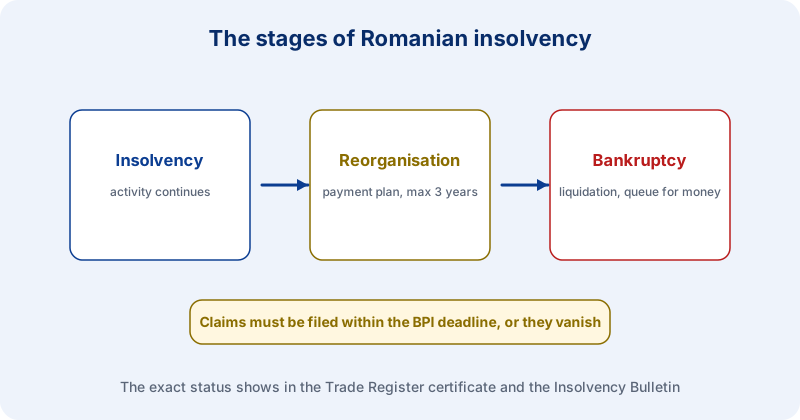
Insolvency proceedings opening is not automatically the end. It is a protective procedure: creditors can no longer enforce against the company, and trading continues under the supervision of a judicial administrator while a way out is looked for.
Judicial reorganisation means a plan of up to three years has been approved, under which the company pays its debts partially and in instalments while continuing to operate. Creditors usually receive less than they are owed, but they do receive.
Bankruptcy means the rescue failed. Assets are sold and the proceeds distributed in the statutory order of priority. Unsecured creditors sit at the very end of that queue and in practice most often get nothing.
What to do if you are already a creditor
From the opening of proceedings you have a short deadline, stated in the notice published in the bulletin, to file a declaration of claim. Miss it and your claim never enters the table and disappears, however real it is and however many invoices you hold. It is the one deadline in this whole process that nobody can rescue afterwards.
What to do if you are not yet dealing with them
Do not agree to payment terms. A company in insolvency can still enter new contracts, but payment upfront is the only sensible condition, and for larger amounts it is worth asking the judicial administrator directly whether the transaction is approved.
The short version
Our instant company check scans the company's court files and flags insolvency and bankruptcy indications found there, alongside tax status and the figures from the last five sets of accounts, for 39 RON. For the official status as written in the register, the one you put in a file, you still want the Trade Register certificate.
Who runs this check, and when
Three groups end up here. Suppliers about to grant payment terms. Buyers about to send a deposit. And people who have already delivered, have not been paid for months, and are trying to work out whether the silence at the other end is disorganisation or something worse. The first two are cheap conversations. The third one is where money is already at risk.
The habit worth building is checking at the moment of exposure rather than at the moment of introduction. A company that looked healthy when you signed the framework contract two years ago tells you nothing about the invoice you are about to issue this month.
What the bulletin will not tell you
Publication starts at the court decision. A company can be out of cash for a year, stop paying suppliers and lose its bank facility while the bulletin stays empty, because nobody has filed yet. There is no early warning in there, only a record of what a court has already decided.
It also will not tell you how much is left. The reports mention assets and claims, but the figure a creditor actually cares about, what a given class recovers in the end, becomes visible only at distribution.
Insolvency, dissolution and struck off are three different things
Dissolution means the company is being wound up. That happens for ordinary reasons too, including a decision of the shareholders, and a dissolved company can be perfectly able to pay everyone.
Struck off, radiata in Romanian, means the company has ceased to exist as a legal person. There is nobody left to sue and nothing left to chase.
Insolvency is about the inability to pay debts that are due, and it can still end in recovery. Reading one status for another sends you down the wrong route: filing a claim in a procedure that closed years ago, or writing off a debt owed by a company that is still trading and still has to pay you.
The mistake most people make
Searching by name and stopping there. Company names repeat in Romania, and the bulletin accepts the tax ID for a reason: it is the only identifier that belongs to one company and one only. If what you found does not carry the tax ID printed on your invoice, you have not found anything yet.
The second mistake is treating the opening of proceedings as the end of the conversation. The company still exists, often still has its director in place, and still has an interest in keeping suppliers. What changes is who decides and what you can safely accept as payment terms.
If you are already a creditor, in order
File the declaration of claim inside the deadline stated in the notice, with the contract, the invoices and the delivery evidence attached. Then watch for the preliminary table of claims and check that your amount is there in full and in the category you expected. If it is missing or cut, there is a separate and equally short deadline for contesting the table, published in the same bulletin. Creditors who file on time and then stop reading the file often discover months later that they were entered for a fraction of the sum, at a point where nothing can be done.
Debts created after the opening are handled separately from the old ones. If you are asked to keep supplying, get the arrangement confirmed by the judicial administrator in writing before the goods leave your warehouse, not after.
Be honest about the odds
Filing a claim is worth doing and costs little. Expecting to be paid in full is another matter, since unsecured creditors sit behind secured creditors, procedural costs, employees and the tax authority. The value of checking is not in recovering what is already lost. It is in not becoming the creditor of a company you could have spotted beforehand.
When you need it on paper
A screenshot from the bulletin is information, not a document. Banks, notaries, courts and public buyers want the status as attested by the register, which is what the certificat constatator states in one line. Anyone can order one for any company, without being a shareholder or a director.
Fill in a form, pay online and receive the electronically signed document by email.
Check the company and its court cases (39 RON, ~60 seconds) →