39 RON (about €8), by email in ~60 seconds, electronically signed
Most people ask this question too late, after the goods have shipped and the invoice is sixty days old. It is worth asking earlier, because a Romanian company with tax arrears pays its suppliers last: ANAF can seize the bank accounts directly, and whatever survives that gets divided among everyone else. No public register lists "what company X owes". The state does leave enough traces to work it out.
Why you cannot pull someone else's tax clearance certificate
The document that states in black and white what a company owes to the state budget is the certificat de atestare fiscala, issued by ANAF. Only the taxpayer or someone they have authorised can obtain it. For a contract of any size, the simplest route is to ask your counterparty for it. A company with clean accounts sends it within two days, and one that stalls has already answered the question.
The public debtor list, and what it leaves out
ANAF publishes a quarterly list of taxpayers with outstanding obligations on anaf.ro. It is free and searchable by name or tax ID. The catch is that it only includes debtors above certain thresholds, which differ by taxpayer category. A small company owing the equivalent of a few tens of thousands of lei can be missing from it entirely. Absence from the list guarantees one thing only: no large debts.
The balance sheet, the only figure that shows the total
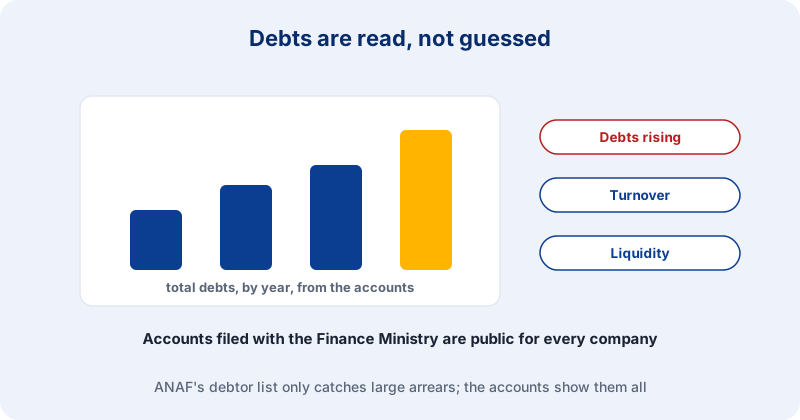
Annual financial statements filed with the Ministry of Finance are public and searchable by tax ID. The "Datorii" line adds up everything the company owed on 31 December: suppliers, banks, the state, shareholders. It does not say to whom, but it says how much, and set against turnover and equity that says plenty. A company carrying debts worth three times its annual turnover is well past a liquidity problem.
Watch the age of the data. Statements for one year are filed by the end of May of the next, so at best you are reading a photograph a few months old, and in January one that is eighteen months old. The balance sheet gives you the trend, with a delay.
The indirect signals, which are current
Tax status at ANAF updates continuously and is public. A company declared fiscally inactive got there by failing to file returns or by being unreachable at its registered address, and that almost always travels with arrears. A VAT number cancelled ex officio tells the same story. Both of these hit you directly: invoices from an inactive taxpayer give you no deduction right, for VAT or for the expense, so their problem becomes your loss.
The second trace is the court portal. An unpaid creditor eventually sues, and cases with the object "pretentii", meaning a money claim, in which the company is the defendant are exactly that: people chasing what they are owed. Ten of those in a single year stop looking like bad luck.
What to do with what you find
If the signals are clean, carry on. If they are not, you do not have to walk away; you can change the terms. Payment upfront instead of net thirty, delivery in stages, or a guarantee. The risk stays there whether or not you look at it, and seen early it costs far less.
The short version
All of the sources above are public, free, and spread across four different Romanian-language websites, and with patience you can work through them yourself in an hour. If you do not have the hour, our instant company check pulls tax status, VAT status, the debt figures from the last five sets of accounts and the court cases into one PDF with a colour verdict, in about a minute, for 39 RON. The ANAF debtor list and the tax clearance certificate stay outside it; they are described above precisely so you know what the report does not cover.
Fill in a form, pay online and receive the electronically signed document by email.
See balance sheet debts and court cases (39 RON, ~60 seconds) →