79 RON (about €16), by email in ~10 minutes, electronically signed
A tidy website and an invoice with a letterhead prove nothing. The company behind them may have been struck off two years ago, leaving you negotiating with a legal person that no longer exists. The consequence is concrete: if the company has been struck off, there is nobody to sign the contract with and nobody to sue.
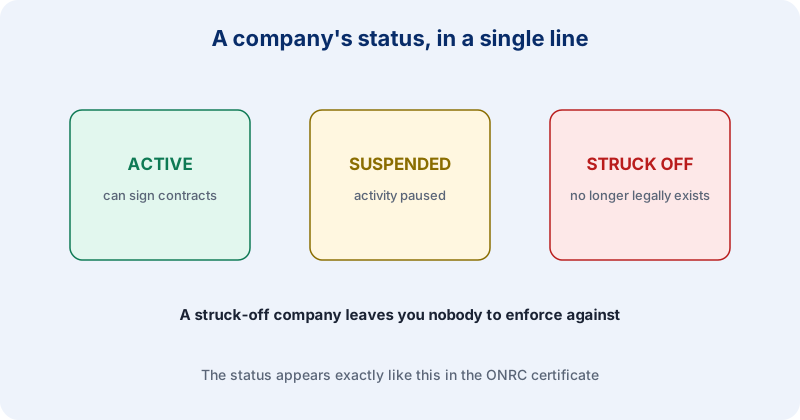
The four states people confuse
Suspension of activity is a declared pause at the Trade Register, for a maximum of three years. The company still exists, keeps a valid tax ID and a director, but carries out no activity and should not be issuing invoices. It can be reactivated at any time.
Dissolution is the decision to end the company's existence, taken either by the shareholders or by a court acting on its own motion. The most common trigger for court-ordered dissolution is mundane and very frequent: the registered office lease expired and was never renewed. From dissolution onwards the company can only carry out operations needed for liquidation.
Liquidation is the stage where assets are sold, debts paid and whatever is left distributed. The company still exists, but only in order to close.
Radiere, being struck off, is the end. The company is deleted from the register and ceases to be a legal person. A contract signed after that date simply has no counterparty.
Where to check
Basic search on the Trade Register portal is free and returns the name, unique code and status by tax ID or name. It is enough for a quick look, but the result is a web page rather than a document. You cannot put it in a file and no bank or notary will accept it.
When you need proof rather than information, you order the certificat constatator. It is the official ONRC document, electronically signed, stating the company's current status, registered office, shareholders, directors and their powers of representation. It costs 79 RON, arrives by email in about ten minutes, and you order it with the tax ID alone.
The check that matters just as much: who can sign
An active company whose signatory has no power of representation produces exactly the same outcome as a struck-off one: a contract you cannot enforce. The Trade Register certificate shows who the directors are and whether one of them can bind the company alone or only jointly with another. Almost everyone skips this check, and it is the one that costs the most.
And the financial side
Legal status tells you the company exists. It does not tell you whether it can pay. For that you look at ANAF tax status, the figures in the filed accounts and the court files, gathered in our instant company check, 39 RON and about a minute. The two documents answer different questions and you usually want both: one says who the company is, the other how it is doing.
A fifth word that gets mixed into the same conversation
Insolvency is a separate procedure with its own rules, and it is not dissolution. A company in insolvency still exists as a legal person, still has a tax ID, and in many cases still trades under supervision. It may come out the other side. Reading the word as a synonym for closed is a mistake in one direction, and treating it as business as usual is a mistake in the other. What it does tell you is that payment terms have stopped being a matter between you and your contact.
Search by code, not by name
Names change, and similar names are common. The registration code stays with the company through every rebrand, so use the code wherever you have one. Take it from the invoice or the contract header rather than from a website footer, and check that the code on the invoice matches the code in the contract. When those two differ, that is usually the entire story: you negotiated with one company and were invoiced by another.
What the free search will not settle
The portal gives you a name, a code and a status. It does not give you the date the status changed, it does not name the people entitled to sign, and it produces nothing you can put in a file. If your question is whether an enquiry is worth answering, the free search is enough. If your question is whether you can safely sign, it is not.
When people run the check, and when they should
Most checks happen after something has already gone wrong. Goods paid for and never delivered, an invoice unanswered for months, a contact who stopped picking up the phone. At that point the check only tells you how bad the situation is.
The useful moments come earlier. Before an advance leaves your account. Before you sign a lease or a distribution agreement that ties you to one partner for years. Before you grant payment terms to a new customer instead of asking for money up front. And once more before a large order with a partner you have not invoiced in a year, because a company can travel from active to dissolved on nothing more dramatic than an office lease nobody renewed.
The date matters as much as the status
A certificate is a photograph of the register on the day it was issued. One ordered in March says nothing about June. Banks, notaries and courts normally want a recent document, so ask how recent before you order rather than after. And when you are the one doing the checking, order close to the moment of signature, not at the opening of a negotiation that then runs for two months.
If the company has already been struck off
Getting money back from a company that no longer exists is work for a lawyer, and it rarely ends well. There is no counterparty to sue and no registered office to serve papers on. Whether anything can be pursued against the people behind the company depends on facts no search result will show you, so take the documents to a lawyer early instead of writing to an address nobody reads.
Prevention costs a fraction of that conversation, and that is the real argument for checking, rather than any quality of the document itself.
For buyers outside Romania
The register is in Romanian and the certificate is issued in Romanian. If it has to go into a file in another country, ask whether a sworn translation is required, because that is a separate step with its own timing. Build it into the schedule rather than finding out on the morning of the signing. The same applies to any legalisation the receiving institution may want: the document is quick, everything wrapped around it is not.
Fill in a form, pay online and receive the electronically signed document by email.
Order a Trade Register certificate (79 RON, ~10 minutes) →