39 RON (about €8), by email in ~60 seconds, electronically signed
The CUI (cod unic de înregistrare) is a Romanian company's tax identification number; checking it against ANAF's registers and VIES tells you whether the company exists, is fiscally active and holds a valid VAT number. That check is the cheapest insurance in accounting. It takes a minute, it is free, and it saves you from the one surprise that costs real money without you having done anything wrong: an invoice from a company declared fiscally inactive, which you are not allowed to deduct.
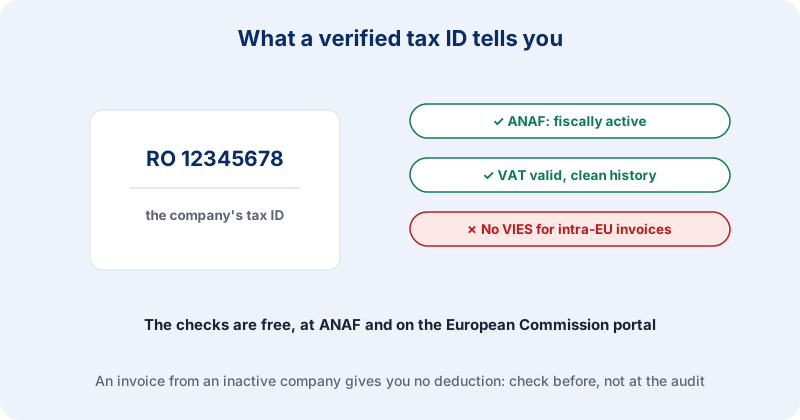
The ANAF register, the official source
ANAF publishes a register of taxable persons, searchable free of charge by tax registration code. You get the exact company name, the declared registered office, whether it is registered for VAT and since when, whether it applies VAT on collection and, most importantly, whether it is listed as fiscally inactive or has had its VAT number cancelled ex officio.
Whose problem fiscal inactivity really is
A company becomes fiscally inactive because it stopped filing returns for a period, or because it could not be found at its declared address. The consequence lands on you: invoices issued by an inactive taxpayer give you no deduction right, neither for VAT nor for the expense. You pay for the goods, you pay the VAT, and then you pay it again at inspection, with interest. It is the kind of loss you discover two years later, when the company in question no longer exists.
The same logic applies to a VAT number cancelled ex officio. A company in that position has no right to charge VAT, so an invoice from it showing VAT is a defective invoice you cannot deduct.
VIES, for intra-community transactions
If the invoice crosses a border inside the EU, the VAT number has to be valid in VIES, the European verification system. A common misunderstanding sits here: a VAT number valid in Romania is not automatically valid in VIES. Registration for intra-community operations is separate, and if your partner does not have it, the exemption on intra-community supply does not apply and you are left owing the VAT. The check is free on the European Commission portal, and it is worth repeating for every new transaction, because a number can be cancelled in the meantime.
What a valid tax ID does not tell you
That a company is fiscally active with its VAT in order only means its paperwork is up to date. About the money in its account, or the way it pays its suppliers, it says nothing. The tax ID is the first filter, not the only one.
Reading the number itself
Two identifiers get confused constantly. The tax registration code is the company's fiscal identity; the trade register number is its registration entry with the register office, and it looks nothing like the first. On invoices, a company registered for VAT writes the RO prefix in front of its code. A supplier that prints RO in front of a code the ANAF register shows as not registered for VAT is either careless or charging you tax it has no right to charge, and either way the deduction is gone.
Having no VAT number is not a red flag
Small companies operating below the registration threshold legitimately have no VAT number, and their invoices carry no VAT. That is ordinary and not worth an argument. What is not ordinary is such a company adding VAT anyway. Check the register, and where the invoice and the register disagree, ask for a corrected document before you pay rather than after, because afterwards you are asking a favour instead of stating a condition.
VAT on collection changes your timing
If the register shows that your supplier applies VAT on collection, the effect on you is about when, not whether. Your accountant needs to know, because the deduction does not follow the invoice date in the usual way. It is the kind of detail that surfaces during a reconciliation months later, and it takes ten seconds to note down when you first look the company up.
When to run the check
Before the first invoice from a new supplier, and before any payment large enough to hurt. For suppliers you buy from every month, repeat it periodically, because fiscal status is not a permanent characteristic: a company in good order in March can be declared inactive in September and nobody will write to tell you. The registers carry dates, and the dates are the point, since what matters is whether your invoice falls inside the inactive period.
Keep the proof
Save each check as a PDF with the date visible and file it with the supplier contract. It costs nothing and it is the only evidence that you looked before you paid. It also settles the internal question of who approved the supplier, which in most companies is the more awkward conversation.
When a supplier turns inactive halfway through
Stop paying against invoices issued in the inactive period and talk to your accountant before doing anything creative with them. A company can be reactivated once it sorts out its filings, and the invoices it issues after that are ordinary invoices again. The ones from the inactive stretch stay what they were, which is why the dates on the register tell you more than the current status shown in green.
The short version
Our instant company check queries ANAF tax status, VAT status with its history and the intra-community code in VIES, then adds the figures from the last five sets of accounts and the company's court files. The result is a PDF with a colour verdict and a confidence score, for 39 RON, with no account and no subscription. The free checks described above remain available to you at any time; the report gathers them in one place, together with the part you will not find in any register.
Fill in a form, pay online and receive the electronically signed document by email.
Check CUI, VAT, VIES and the rest at once (39 RON) →