39 RON (about €8), by email in ~60 seconds, electronically signed
Civil court files are public in Romania, and this is one of the most underused sources of information about a business partner. The balance sheet shows you what the company looked like a year ago. The court files show you how it treats the people it works with, right now.
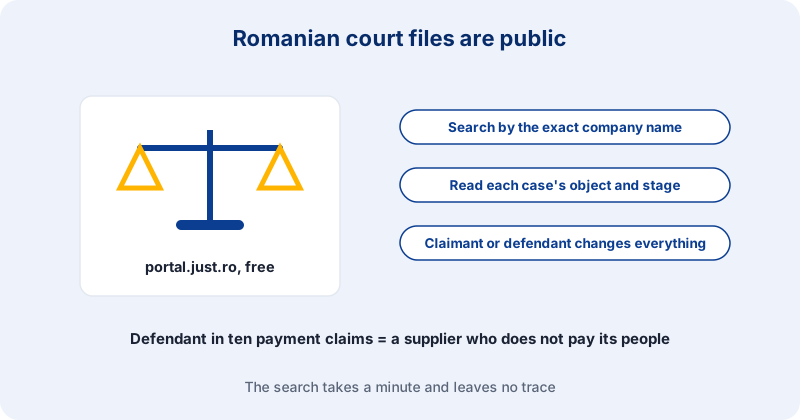
Where to search
The courts portal, portal.just.ro, is free and searchable by party name. Enter the company name and you get the files it appears in, with the case number, the court, the object, the procedural stage and the hearing dates. The interface is Romanian only.
There are two traps. First, the search runs on name rather than tax ID, and Romania has dozens of companies sharing a name. You have to confirm the file belongs to your company, usually from the registered office or the registration number appearing in the case documents. Second, results are spread across courts, so a company operating in several counties has files at each tribunal separately. For the full picture you have to repeat the search at every court where the company might have cases.
What a case file tells you
The object says what the dispute is about. "Pretentii" means a money claim. "Ordonanta de plata" is the same thing on a fast-track procedure. "Contestatie la executare" means somebody is enforcing against the company and it is fighting back. "Litigiu de munca" is a dispute with its own employees, and "procedura insolventei" speaks for itself.
The party's capacity matters as much as the object. A company appearing ten times as claimant in money claims is chasing what it is owed, which is a sign of discipline. The same company appearing ten times as defendant in the same type of case means others are chasing it, and you are next in line.
The stage tells you whether this is old news. A file on appeal from 2021 and one registered last month say very different things about the situation today.
How many is "a lot"
There is no universal threshold, because it depends on size. A single money claim against a company with three employees weighs more than thirty against a retailer with a thousand stores. Set the number against the size of the business and watch the trend above all: if half the files date from the last twelve months, something broke recently.
What you will not find there
The portal covers the courts. It does not cover arbitration, mediation, or debts nobody has sued over yet. No court files is a good sign, but it is not a clean bill of health.
The short version
Our instant company check runs the search for you and returns the files grouped, with the number, court, object, stage and the company's capacity in each, plus any insolvency indications found there. It comes together with tax status, VAT status and the figures from the last five sets of accounts, in a PDF with a colour verdict, for 39 RON.
Making sure the file is really theirs
Open the file and look at the party details. Court documents usually carry the registered office and often the registration number, and that is what you match against the data you already have on the company. If neither appears anywhere, treat the file as unconfirmed rather than as evidence. Two companies sharing a name in different counties is common enough that acting on the wrong one is a real risk, and the wrong one is often the one in trouble.
Reading the dates
A file with a hearing set for next month is live. A file whose last entry is three years old is probably over, and where the solution is published you can read what it was. What you are looking for is not a single verdict but a rhythm. Files appearing steadily over the last year mean the company is currently in conflict with the people around it, whatever the outcome of any one case turns out to be.
What you do with what you find
Rarely a straight no. More often a change of terms: payment on delivery instead of thirty days, a smaller first order, a guarantee for the larger ones, invoicing earlier in the cycle. You can also just ask. A company with two files it considers unfair will explain them in a minute, and one that gets uncomfortable at the question has told you something the portal could not.
When to run it
Before the contract, and again before any exposure that would actually hurt. Companies are not static, and the check that reassured you at signature says nothing about the delivery you are loading today. The natural moments are the first order, the first increase in credit, and the renewal.
Misreadings worth avoiding
A company that sues a lot is not automatically a bad partner. Chasing your own debtors through the courts is what a disciplined business does, and it is the opposite signal from being chased. Look at capacity before quantity.
One case is not a pattern either. Any company that trades long enough collects a dispute, and a single money claim from four years ago that ended in a settlement tells you very little.
Enforcement contestations are heavier than they look. Somebody already holds an enforceable title against the company, which means the debt has already been established somewhere and the stage of arguing about it has passed.
Employment disputes read differently
A run of labour cases does not necessarily mean the company cannot pay, but it does describe how it behaves under pressure, and unpaid wages are usually the last thing a business stops paying. Read them together with what you find in the accounts rather than on their own.
The official document, if you need one
Court files are information you use to make a decision. When a bank, a notary or a public buyer asks for the company's standing on paper, that comes from the register instead: the certificat constatator sets out the company's data and its status as recorded there. The two answer different questions, and it is worth knowing which one you actually need before ordering anything.
Fill in a form, pay online and receive the electronically signed document by email.
See every court case, with statistics (39 RON, ~60 seconds) →