39 RON (about €8), by email in ~60 seconds, electronically signed
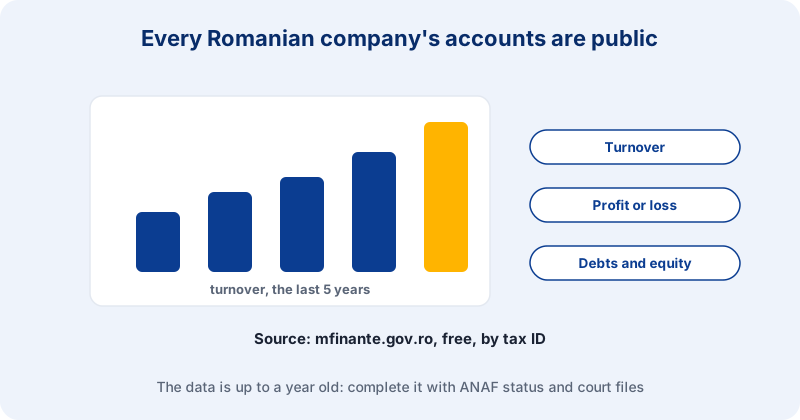
Every company registered in Romania files annual financial statements, and those statements are public. You need neither an account nor a subscription to a commercial database to find out what turnover your prospective partner had last year, what profit it reported and how many people it employs.
Where to search
The Ministry of Finance publishes a tax information and balance sheet section on mfinante.ro, searchable by unique registration code. You get year-by-year summaries with the main indicators. It is free and it is the primary source, meaning exactly what the company filed, with nobody in between. The site is in Romanian.
How fresh the data is
This is the limitation to plan around. Companies file their annual statements within 150 days of the end of the financial year, so by the end of May for the previous year. In February the newest figures available are fourteen months old, and by June they become six. The balance sheet is an archive photograph: it shows the direction of travel, with a delay.
What to read, in order of importance
Turnover, compared across several years rather than taken for the latest one alone. A fall from a million to three hundred thousand over two years says more than any single figure.
Profit or loss. A loss in one year is not a disaster and may well be an investment. A loss three years running is a pattern.
Equity. If it is negative, the company has accumulated losses larger than everything ever put into it. Romanian company law requires shareholders either to restore the capital or to dissolve the company when net assets fall below half the share capital, and in practice many companies sit in that state for years.
Total liabilities, set against turnover and equity. Heavy borrowing is not automatically bad, but it means the company has other mouths to feed before yours.
Headcount, placed next to turnover. A company promising deliveries worth millions with two employees deserves follow-up questions, and one whose turnover per employee sits below the national average wage has a productivity problem you will feel in its delivery dates.
What the accounts do not show
They do not show who the company owes money to, they do not show individual unpaid invoices, and they show nothing at all about the current year. For that you look at ANAF tax status, which is current, and at the court files.
Who reads these numbers, and when
The usual moment is a first order from a supplier you have not worked with, especially one that wants money before it ships. Other moments: you are about to grant payment terms instead of asking for cash up front, you are signing a distribution agreement that ties you to one partner, or you are a landlord vetting a company that wants a three-year lease. Recruiters use the same figures before accepting an offer from a small employer.
The timing rule is simple. Look before the advance leaves your account, not after the contract is signed. Once the money has moved, the accounts stop being a decision and become reading material.
The mistake most people make
Treating turnover as money in the bank. Turnover is what the company invoiced, not what it collected. A company can post its best year ever and still be unable to pay you, because its own customers have not paid it. The gap between the two lives in receivables, and it is why a profitable company can go under.
The second mistake is the age argument. A long registration history sounds reassuring, but companies get sold, and a dormant shell can be bought and put back to work in a week. What matters is who owns it now and what it has done recently, not the registration date.
When there are no accounts to read
A company registered this year has nothing filed yet, and that is normal rather than suspicious: the first set is due after its first financial year closes. What is not normal is an older company with gaps in the sequence. A missing year is a question worth asking out loud, because filing is an obligation and skipping it usually means either the company stopped trading or nobody is minding the paperwork.
Size also changes what you see. Smaller companies file a shortened set of accounts, so the line-item detail you would expect from a large filer is simply not there. You still get the headline figures, which is what most decisions need.
Ask for something newer
Because filings lag, the honest move in a negotiation is to ask the company for a recent trial balance, the balanta de verificare, signed by its accountant. It costs the company nothing to produce and it covers the months the public filing cannot. A company in reasonable shape hands it over without drama. A refusal is information too, though not proof of anything by itself. This does not replace the filed accounts, which nobody can edit for your benefit; it fills the gap between the last filing and today.
Which register answers which question
The accounts on mfinante.ro tell you how last year went. The Trade Register tells you who owns and runs the company today and whether insolvency proceedings have started. ANAF records tell you whether it is VAT registered and whether it has been flagged as inactive. Court files tell you who is suing it and for what. People mix these up constantly: they read a decent profit from two years ago, feel reassured, and miss that the company was declared fiscally inactive last month.
One practical note for readers outside Romania. The filed figures are in lei, not euro. Convert before you form an opinion about the size of the business, and use the exchange rate of the year the figures belong to if you are comparing several years.
Accounting and reporting in Romania: the obligations behind the filings
The public figures exist because Romanian accounting law makes them mandatory. Every company files annual financial statements with the Ministry of Finance, generally by the end of May for the previous year, and larger companies file more detailed sets than small ones. Micro and small entities report a simplified package: balance sheet, profit and loss, and a few notes. There is no equivalent of a public quarterly report; between two annual filings, the registry stays silent.
Two consequences matter for anyone doing due diligence. First, the freshest public numbers can be up to seventeen months old by the time you read them, so treat them as history, not as today's bank balance. Second, a company that has skipped its filing obligation is itself a signal: the ANAF status check will often show it declared inactive, which our instant company check flags automatically. For the ownership side of the same due diligence, the UBO register Romania guide explains who controls the company behind the numbers.
The short version
Our instant company check brings you the figures from the last five sets of filed accounts, or however many exist for a younger company, in a chart, together with profit margin, year-on-year growth, leverage, liquidity and turnover per employee, each with a plain explanation. On top of that it adds tax status, VAT status and the court files, closing with a colour verdict and a score from 0 to 100. It costs 39 RON and takes about a minute.
Fill in a form, pay online and receive the electronically signed document by email.
See five years of figures, charted and explained (39 RON) →