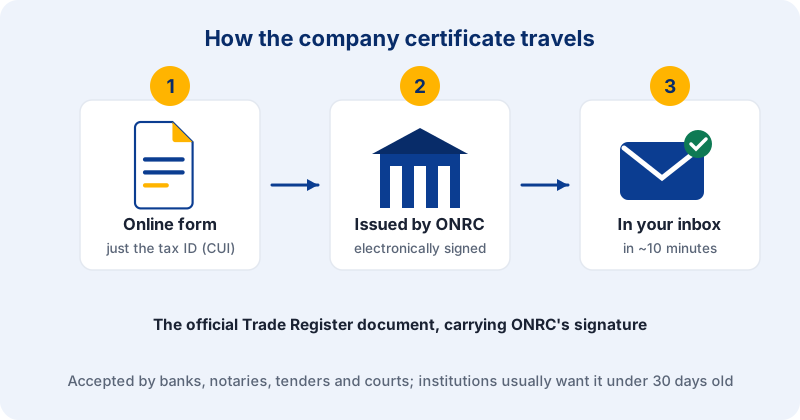
79 RON (about €16), by email in ~10 minutes, electronically signed
The certificat constatator is the official company status certificate issued by the Romanian Trade Register (ONRC): it shows a company's current legal status, registered office, shareholders, directors and activity codes. If you deal with Romanian companies, sooner or later somebody asks you for one. A bank wants it before opening an account or granting credit. A contracting authority wants it in a tender file. A partner wants it before signing, a funder before releasing money. The document is always the same one. What changes is the context and the deadline, and that is the difference between a formality and a crisis.
What is in it
The certificate is issued by the National Trade Register Office (ONRC) and contains the company's identification data, its registered office, its duration, the shareholders and directors with their details, the licensed activities by CAEN code, the share capital, and the company's status: active, suspended, in insolvency or struck off. It is the company's official identity sheet and it carries ONRC's electronic signature, which is what makes it usable in front of a bank or a court.
What it does not show
The certificate is a registry document. It proves who the company is, not how it is doing. It says nothing about unpaid taxes, bank balances, pending court cases, pledges over the company's assets or whether last year's turnover was collected. A company can be perfectly active, with clean data at ONRC, and still owe money to everyone it works with. If the question you actually have is whether this company can pay, the certificate is the wrong document. That answer sits in the fiscal and financial side, which is a separate check: the company check report for the current situation, the filed financial statements for the numbers.
Who asks for it, and when
Banks ask when you open an account, change a signatory or apply for credit, because they need to know who can legally commit the company. Contracting authorities ask because the tender file requires the bidder's registry situation. Notaries ask before a company signs a sale or a mortgage. Courts ask so that the summons reaches the correct registered office and the correct representative. Foreign partners ask because they cannot read the Romanian register themselves and want something official to put in the file. The document is the same in all of them. Only the deadline changes.
The 30-day rule
Institutions want a document that reflects reality now, not a year ago. The practice is close to universal: the certificate must have been issued within the last 30 days. There is no point keeping a spare copy in a drawer. You order it when somebody asks, on the data of that day.
Simple or with history
The basic version shows the current situation and covers most requests: banks, tenders, contracts. The historical version adds the full sequence of changes since incorporation, who entered and left the company, how the registered office moved, how the capital changed. Lawyers ask for it in transactions, as do courts and serious due diligence. If whoever asked did not say the words with history, the simple version is the one they mean.
How to get it
Directly from ONRC, through the institution's own portal, with an account and the official fee of 30 lei. That route works if you read Romanian and have the patience for the platform. On acte-rapide.ro you enter only the company's tax identification number, pay 79 RON as a final price and receive the certificate by email in about ten minutes, at any hour, including the Sunday you discovered that the tender closes on Monday morning. The certificate is the same ONRC original with the same electronic signature either way. The difference of roughly 49 lei buys the absence of an account, a platform and an opening-hours schedule.
Reading it as a counterparty
If you asked for the certificate because you are about to do business with the company rather than because it is your own, read the status line first, then the directors, then the share capital against the size of what is being promised. A company incorporated three months ago, with 200 lei of capital and a director who replaced the previous one last week, is not automatically a fraud. Combined with a request for advance payment, it is a pattern. We wrote a longer piece on checking a Romanian company and on the red flags that matter.
The electronic signature is the document
What you receive is a PDF signed electronically by ONRC. The signature is the proof and it lives inside the file. Print it and you hold paper with no verifiable origin; scan that printout and you hold a picture of paper. Send the original PDF as a file to whoever asked for it. If someone insists on a stamped hard copy, tell them the electronic original is what the institution issues now, and that the signature can be checked in any PDF reader. Forwarding the email you received usually ends the discussion faster than explaining it.
When the data in it looks wrong
The certificate copies the register. If a change was decided but never filed, or filed and not yet processed, the certificate keeps showing the old situation, and that is not an error in the document. Ordering a second one changes nothing. The fix is a filing at ONRC, and only once that goes through will a fresh certificate show the new reality. Plan around it: if you sold shares or replaced the director last week and a bank wants the certificate tomorrow, check first that the change is actually registered.
Confusions worth clearing
The certificat constatator is not the certificat de inregistrare, the registration certificate a company keeps in its own file; that one shows the company was registered, not what its situation is today. It is not a tax clearance certificate either, and no bank will accept it as one. And with history does not mean older or archived. It means the same current document plus everything that changed before it. When a request mentions an extended or a detailed version without saying more, ask what they need to see before you order. Getting the wrong version costs you a day you may not have. If the underlying question is whether the company still exists at all, that is answered faster by checking whether the company is still registered, and the difference between the two versions is set out in basic versus extended certificate.
One practical habit
For files with a fixed deadline, tenders above all, order the certificate two or three days before submission rather than an hour before. Fresh enough to pass the 30-day rule at evaluation, early enough that you still have time to react if you find something in it you did not know about.
Fill in a form, pay online and receive the electronically signed document by email.
Order a company registration certificate (79 RON, ~10 minutes) →